LangLibra.
Browse
About
Business writing · Inside the organisation

Business memo format and examples

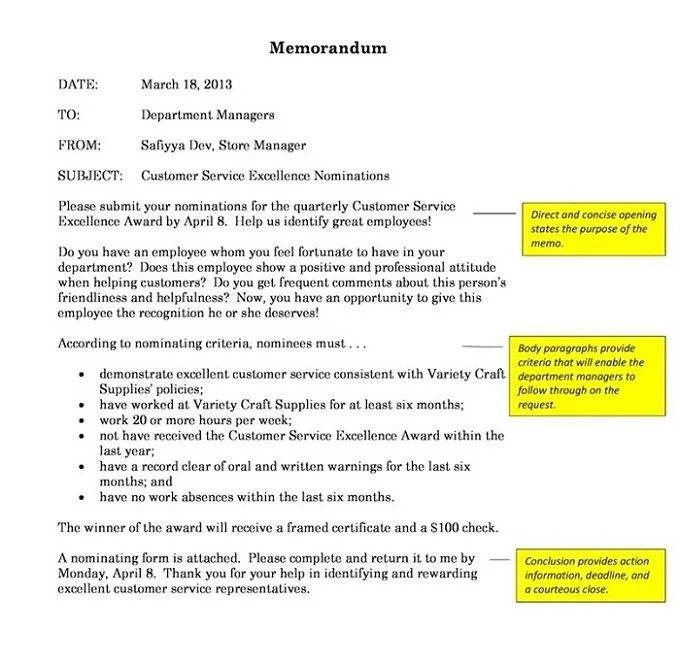
A memo (short for memorandum) is a brief internal document that informs colleagues or asks them to act. It opens with a standard four-line header, states its main point in the first sentence, and rarely runs past one page.

TOFROMDATESUBJECT DirectorThe teamThe file reads line onereads the actionskeeps it all
One memo, three depths of reading. The dark band is the bottom line; the green block holds the actions.

Three memos, one structure

Every memo follows BLUF: bottom line up front. The first sentence carries the news or the request; context, detail and actions follow. Choose a memo type.

MEMO
TO
All staff
FROM
Maria Lopez, Head of People
DATE
3 June 2026
SUBJECT
New expenses policy from 1 July
From 1 July, all expense claims must be submitted through the Spendly app within 30 days of purchase.
Paper forms often arrive months late, which delays month-end accounts. The app lets you photograph a receipt and submit in under a minute.Claims older than 30 days will need approval from your director.
What you need to do
›Install Spendly from the staff app store by 30 June.›Join a 20-minute training session (dates on the intranet).›Submit any paper claims you are holding by 28 June.

The change and its date firstReaders learn what is different before why.A short reasonPeople follow rules more readily when they understand them.Actions as a listEach one starts with a verb and has a date.
How to write business memos people read →

How long, for whom

The more senior the reader, the shorter the memo. Detail moves into attachments rather than disappearing.

Executivedirectors, board 150 to 250 words
Cross-departmentother teams 250 to 400 words
Your own teamcolleagues you work with 400 to 600 words
Policy for all staffeveryone, with attachments 300 to 500 words + FAQ
Bars show typical word counts. An executive memo is a third the length of a memo to your own team.

Memo or email?

A memo is a formal internal document, usually sent as an attachment or posted on the intranet, that people may need to refer back to. An email suits quick updates. Use a memo when the message is a decision or a rule.

Send a memo forAn email is enough for
A new policy or procedureA reminder of an existing rule
A change that affects many teamsA note to one person or team
A decision people must followA question or a request for opinions
Anything that may be checked laterMeeting times and quick updates

Tone in memos

Memos are direct but not cold. Use “we” for decisions the organisation has made, “you” for what the reader must do, and avoid passive sentences that hide who decided.

Instead ofWrite
It has been decided that…We have decided that…
Staff are required to…Please…
Any queries should be directed to…If you have questions, contact Ana Silva.
With immediate effectFrom today

Sending and storing it

  • Send it on a weekday morning, not late on Friday
  • Paste the first paragraph into the email, with the full memo attached
  • Save it where the team can find it later, such as the intranet
  • Date-stamp every version if the memo is updated
  • Link to it from any related policy or FAQ

For a full layout, see memo format, with examples.