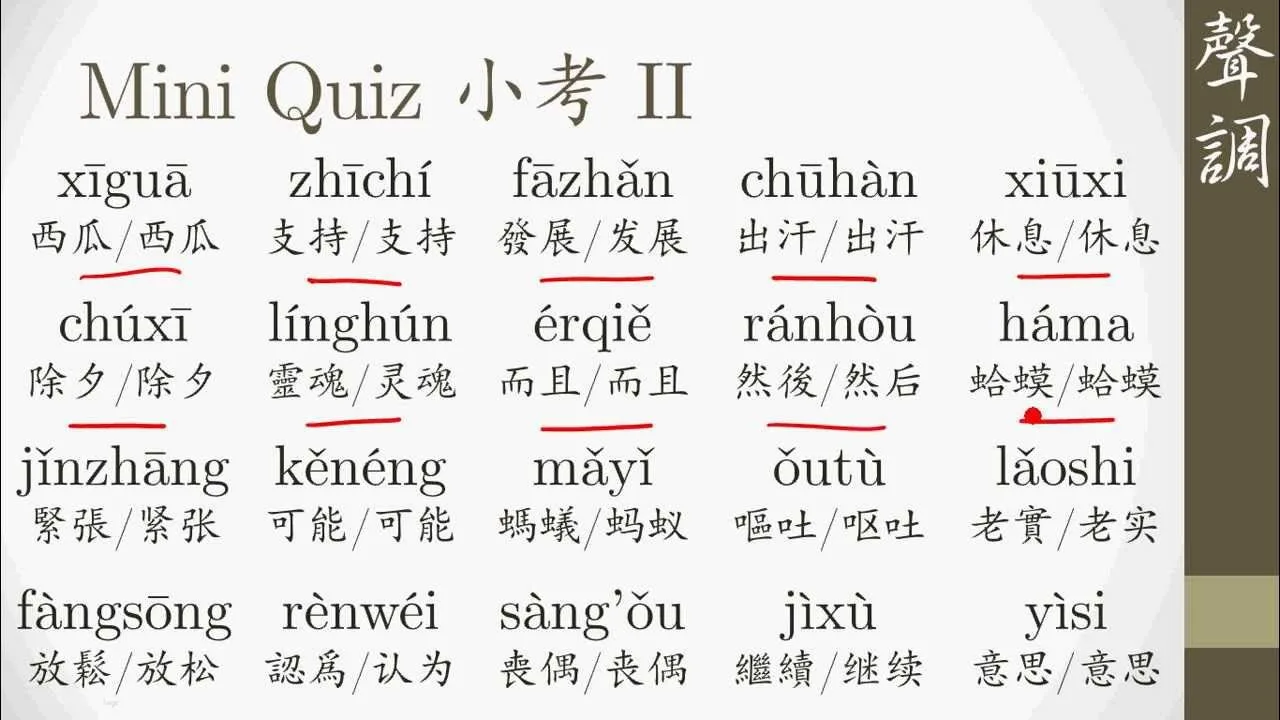
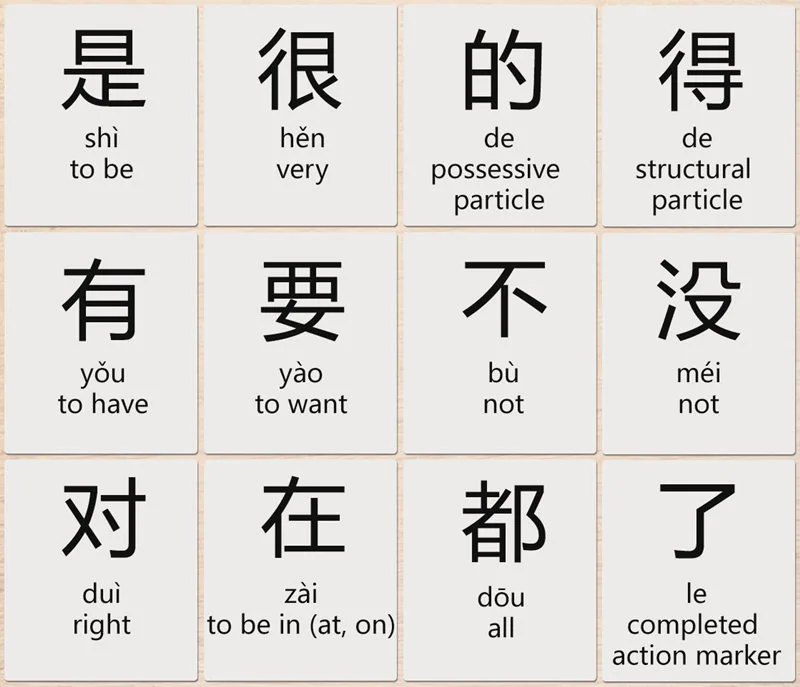
Mandarin grammar is simple in form: words never change their endings, and English word order (subject, verb, object) mostly works. The work is in three other places: tones, which are pitch patterns that are part of every word; characters, which you learn by their building blocks; and small words such as 了 le, 吗 ma and measure words, which do the job that English endings do.
The four tones
Pinyin letters that sound different
Pinyin is the official way of writing Chinese sounds in the Latin alphabet. Most letters sound roughly as in English, but these seven do not. Learn them first and you can read any pinyin aloud.
| Letter | Sounds like | Example |
|---|---|---|
| q | “ch” in cheese, with the lips spread | 七 qī (chee)seven |
| x | “sh” in sheep, said with a smile | 谢谢 xièxie (SHYEH-shyeh)thank you |
| zh | “j” in jam, with the tongue curled back | 中国 Zhōngguó (JONG-gwaw)China |
| c | “ts” in cats | 菜 cài (tsai)dish, vegetable |
| j | “j” in jeep, tongue flat | 九 jiǔ (jyoh)nine |
| r | between “r” in run and “s” in measure | 人 rén (ruhn)person |
| ü | say “ee” with rounded lips, like French “u” | 女 nǚ (nyü)woman |
How characters are built
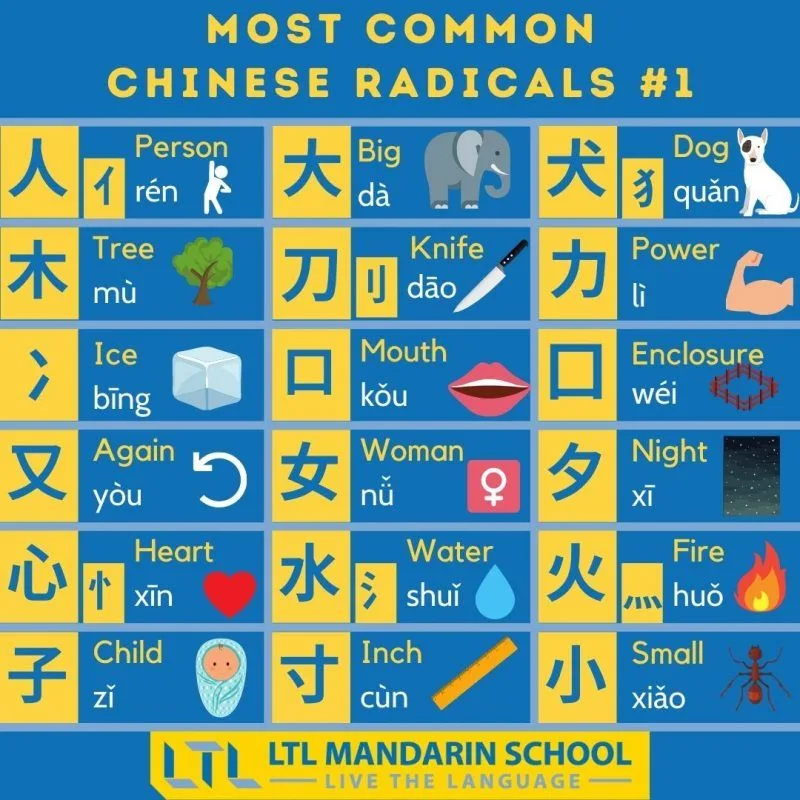
Each character stands for one syllable with a meaning. Most are built from two parts: a radical, which hints at the meaning, and a phonetic part, which hints at the sound. Learning about 200 common parts lets you guess thousands of characters.
The character 马 mǎ, “horse”, works as a sound part in many others. Put “woman” beside it and you get 妈 mā, “mother”. Put “mouth” beside it and you get 吗 ma, the spoken question word. The tone can change, but the sound stays close.
Word order: subject, time, place, verb
Chinese words never change form, so word order carries the grammar. Time and place come before the verb, not after it as in English.
Talking about time without tenses
English changes the verb to show time: eat, ate, have eaten. Chinese never changes the verb. Instead it adds a time word (yesterday, tomorrow) or a small marker that shows aspect: whether an action is finished, ongoing or has ever happened.
Asking questions
Chinese never moves words around to ask a question. You keep the statement order and either add a particle at the end, or put the question word exactly where the answer will go.
Measure words
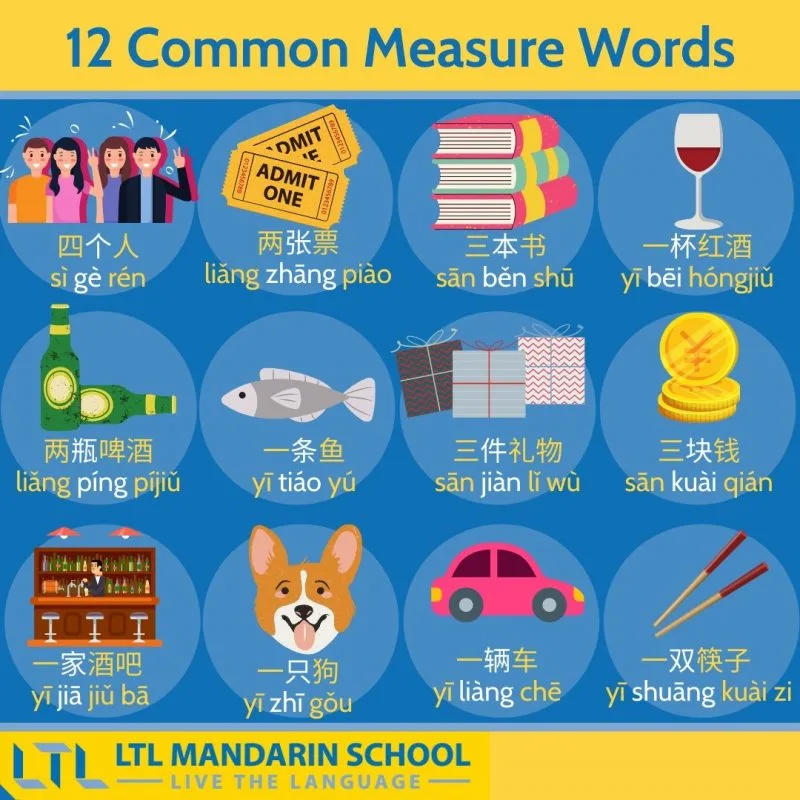
A measure word (or classifier) sits between a number and a noun, like “sheet” in “two sheets of paper”. In Chinese every counted noun needs one. 个 gè is the general one; the others group nouns by shape or type.
| Measure word | Used for | Example |
|---|---|---|
| 个 gè | People and most things (general) | 三个人 sān gè rénthree · (measure) · people |
| 本 běn | Books and bound volumes | 一本书 yì běn shūone · (volume) · book |
| 杯 bēi | Drinks in a cup or glass | 两杯咖啡 liǎng bēi kāfēitwo · cups · coffee |
| 只 zhī | Many animals | 一只猫 yì zhī māoone · (animal) · cat |
| 张 zhāng | Flat things: paper, tables, tickets | 一张票 yì zhāng piàoone · (flat) · ticket |
Polite and casual Chinese
Mandarin grammar does not change with politeness the way Japanese does, but word choice does. Use the polite column with older people, customers and anyone you have just met; the casual one with friends.
| Meaning | Polite | Casual | Why |
|---|---|---|---|
| you | 您nín (neen) | 你nǐ (nee) | 您 is the respectful “you”, common in shops, offices and with older people. |
| hello | 您好nín hǎo | 嗨hāi (high) | 嗨 is borrowed from English “hi” and used between friends. |
| excuse me (to ask) | 请问qǐngwèn (CHING-wun) | 那个…nèige (NAY-guh) | 请问 literally means “please may I ask”; 那个 is a casual “um…” to get attention. |
| thank you | 谢谢您xièxie nín | 谢了xiè le | Adding 您 makes thanks more formal; 谢了 is a quick “thanks”. |
| goodbye | 再见zàijiàn (dzai-JYEN) | 拜拜báibái (by-by) | 再见 literally means “see again”. 拜拜 comes from English “bye-bye”. |
How to start learning Chinese
- 1Master pinyin and tonesSpend the first two weeks on sounds alone, saying every syllable with its tone.
- 2Learn the 100 most common radicalsThey make every new character easier to remember.
- 3Learn words, not single characters电脑 diànnǎo, “electric brain”, is “computer”: learn the pair as one word.
- 4Build sentences in time-place-verb orderPractise with your own day: “Today I at home work.”
- 5Follow the HSK word listsHSK is China’s official proficiency exam; its nine levels (since 2021) set out the words and grammar for each stage, up to full fluency.
Guides on Chinese grammar and vocabulary
20 guides · newest first