LangLibra.
Browse
About
Grammar guide · 11 word pairs

Commonly confused words

The most commonly confused words come in pairs that sound alike but do different jobs in a sentence. Each pair below has a meaning, an example and a quick test you can run while you write, plus a link to the full guide.

fewer things you can count 12345 less amounts you measure fewer cups of coffee · less coffee Test: can you put a number in front of the noun?
Many pairs come down to one question like this. For fewer and less, it is whether you count the thing or measure it.

The pairs at a glance

Affect or effect Full guide →
affectverb: to influence The delay will affect the launch.
effectnoun: the result The effect was immediate.
Quick test: swap in “influence” for affect or “result” for effect.
Their, there or they’re Full guide →
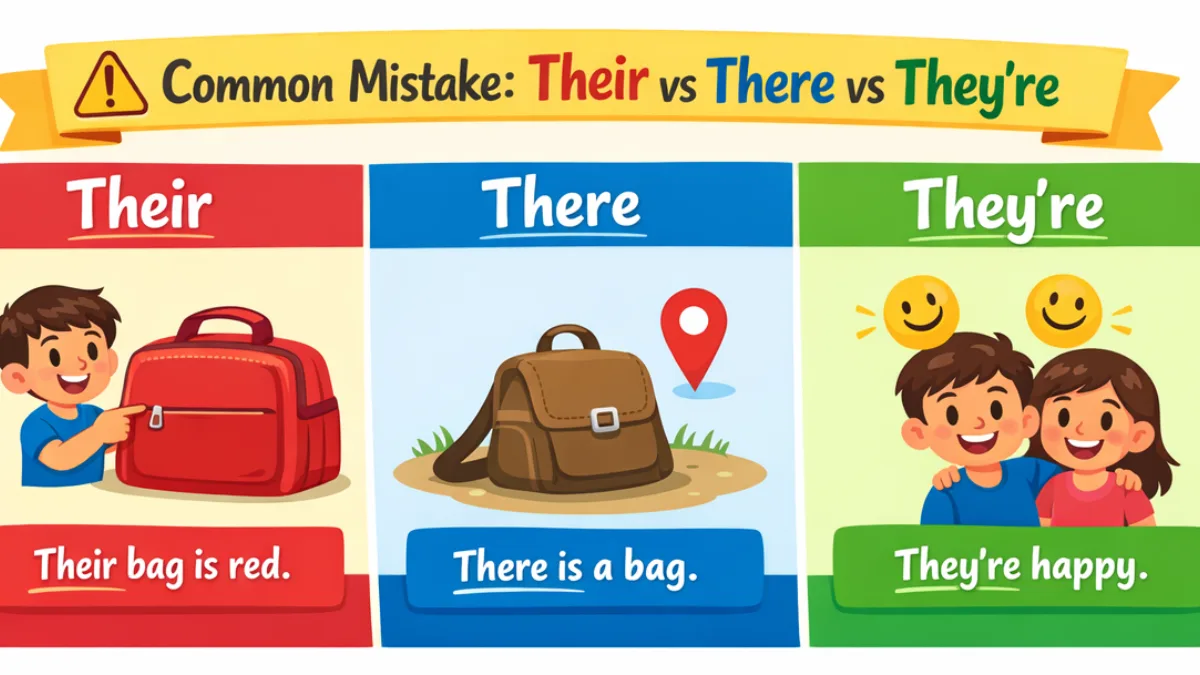
theirbelonging to them Their report is ready.
therea place, or “there is” Put it over there.
they’rethey are They’re on the call.
Quick test: if “they are” fits, write they’re.
Its or it’s Full guide →
itsbelonging to it The team changed its plan.
it’sit is, or it has It’s been a long week.
Quick test: if “it is” or “it has” fits, add the apostrophe. “Its’” is never correct.
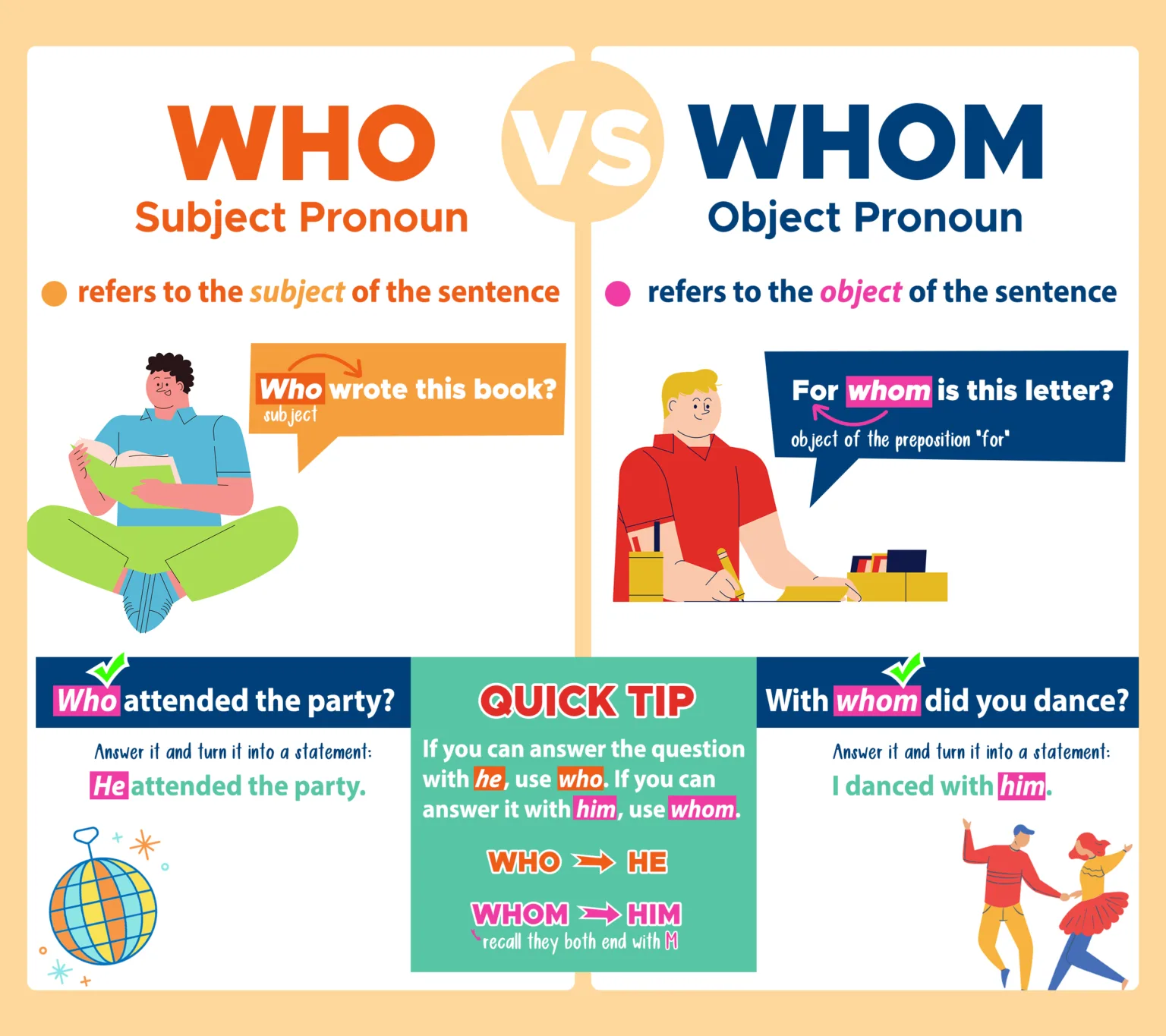
Who or whom Full guide →
whothe one doing the action Who sent the invoice?
whomthe one receiving it To whom should I send it?
Quick test: answer with he or him. He → who; him → whom (both end in m).
Lay or lie Full guide →
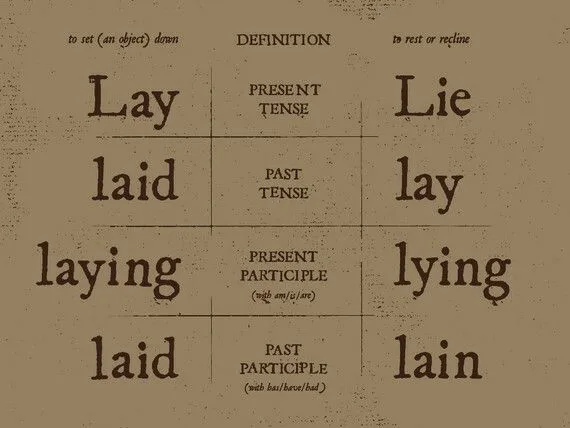
layput something down (laid, laid) Lay the files on the desk.
lierest flat (lay, lain) I need to lie down.
Quick test: lay always has an object: you lay something. Watch the past of lie, which is lay.
Fewer or less Full guide →
fewerthings you count Fewer meetings this month.
lessamounts you measure Less time for each one.
Quick test: can you put a number in front of the noun? Then fewer.
Farther or further Full guide →
fartherphysical distance The office is farther than I thought.
furtherextent, or “more” Let’s discuss this further.
Quick test: could you measure it in miles? Then farther. Further works for both in British English.
i.e. or e.g. Full guide →
i.e.that is: the full meaning the deadline, i.e. Friday at noon
e.g.for example: one of several a document, e.g. a report or memo
Quick test: i.e. = “in essence”; e.g. = “example given”.
Than or then Full guide →
thancomparison This draft is shorter than the last.
thentime or sequence Check the figures, then send it.
Quick test: comparing? than (both have a). Ordering events? then (both have e).
Into or in to Full guide →
intomovement inside She walked into the meeting.
in to“in” belongs to the verb Please hand your forms in to reception.
Quick test: if the verb is a phrase like log in or hand in, keep them apart.
I, me or myself Full guide →
Ithe one acting Priya and I will present.
methe one receiving Send it to Priya and me.
myselfonly when I is already in the sentence I checked it myself.
Quick test: drop the other person: “Send it to me”, so “to Priya and me”.

Three tests that settle most pairs

Most of the pairs above come down to one of three quick checks. Learn the checks and you can work out pairs you haven’t met before.

The substitution test Replace the word with its full form or a synonym and see if the sentence still works. “It’s ready” works as “It is ready”, so it’s. In “The team changed its plan”, “it is” makes no sense, so no apostrophe. its / it’stheir / they’reaffect / effecti.e. / e.g.
The counting test Ask whether you could put a number in front of the noun, or measure the distance. three emails → fewer emails · time can’t be counted → less time fewer / lessfarther / furthernumber / amount
The pronoun test Drop the other person, or answer the question with he or him. Send it to (Priya and) me → “to me”. Who/whom? “Him” → whom. I / me / myselfwho / whomlay / lie

Twelve more pairs for professional writing

These pairs turn up constantly in emails, reports and contracts. Each has a memory hook in the last column.

WordMeansExampleMemory hook
acceptto receive or agree toWe accept the terms.accept: you agree to it
exceptapart fromEveryone except Sam signed.except and exclude both start ex-
complementto complete or go well withThe charts complement the text.complement completes
complimentpraiseThanks for the kind compliment.I like compliments
principalmain; head of a schoolThe principal reason is cost.the principal is your pal
principlea rule or beliefIt’s a matter of principle.principle = rule (both end in -le)
ensuremake certainPlease ensure the door is locked.ensure = make sure
insureprotect with insuranceWe insure all equipment.insure = insurance
stationarynot movingThe car was stationary.a for stand still
stationerypaper and envelopesOrder more stationery.e for envelopes
discreettactful, carefulPlease be discreet about this.discreet keeps a secret
discreteseparate, distinctThree discrete stages.the t separates the e’s

Pairs that depend on British or American English

British English sometimes uses two spellings where American English uses one: one for the noun and one for the verb, or one for each meaning. Pick one variety and keep to it in a document.

British
practice (noun) · practise (verb)Daily practice helps. Practise every day.licence (noun) · license (verb)A driving licence. Licensed to sell.programme (TV, event) · program (software)A training programme. A computer program.further for distance and degreeFurther down the road. Further details.
American
practiceDaily practice helps. Practice every day.licenseA driver’s license. Licensed to sell.programA training program. A computer program.farther for distanceFarther down the road. Further details.

Why these pairs get swapped: sound, spelling and meaning

Not every confused pair is confused for the same reason. A homophone is a word that sounds exactly like another but is spelled differently and means something else (there, their). A near-homophone sounds almost the same (accept, except). Some pairs sound different but share a meaning area (fewer, less). Knowing which kind you are facing tells you which test to use.

Homophones Same sound, different spelling Your ear can’t help, so use the substitution test: expand the word or swap in a synonym. their / there / they’reits / it’sstationary / stationeryprincipal / principle
Near-homophones Almost the same sound Say the word slowly and listen for the first syllable: ac-cept, ex-cept; af-fect, ef-fect. accept / exceptaffect / effectthan / thendiscreet / discrete
Meaning pairs Different sound, overlapping meaning Ask what kind of thing you are describing: countable or not, physical or not, subject or object. fewer / lessfarther / furtherwho / whomlay / lie

Spell-checkers catch none of the first group, because every word is spelled correctly. That is why their, there and they’re and its and it’s need a rule you carry in your head rather than a tool.

Noun or verb? Pairs that change with the job of the word

A noun names a thing (the advice); a verb names an action (to advise). Several pairs are really one word in two jobs, with a different spelling for each. Ask which job the word is doing in your sentence: if you can put “the” or “a” in front, it is a noun.

Noun (a thing)Verb (an action)Example with bothHook
adviceadviseThanks for the advice; I’d advise waiting.c for the thing, s for the action
devicedeviseWe devised a new device.same pattern as advice / advise
practice (UK)practise (UK)Practise daily; practice makes progress.US uses practice for both
licence (UK)license (UK)You need a licence; we are licensed.US uses license for both
effectaffectThe change will affect sales; the effect was small.A for action (verb), E for end result (noun)
lossloseWe lose money on each sale; the loss is growing.lose has one o and is the verb

Affect and effect follow the same pattern most of the time: affect is the verb, effect the noun. The rare exceptions (“to effect change” means to bring it about) are covered in the full guide.

Eight pairs in one email

Confused pairs rarely appear alone. This short email uses eight of them correctly; each highlighted word has a note explaining the choice.

Subject: Office move: what changes on Monday Hi all, The move will affect¹ everyone, but its² main effect³ is more space for every team. The new building is farther⁴ from the station, so allow ten minutes more on the first day. We will have fewer⁵ desks than⁶ before, so please book one in advance. If you have questions, ask Priya or me⁷, and we will ensure⁸ you have what you need. Thanks, Daniel
  1. 1affect verb: the move influences everyone.
  2. 2its belonging to the move; “it is” would not fit.
  3. 3effect noun: the result, after “main”.
  4. 4farther physical distance you could measure.
  5. 5fewer desks can be counted.
  6. 6than a comparison with before.
  7. 7me drop Priya: “ask me”, not “ask I”.
  8. 8ensure make certain; insure would mean a policy.

Guides on commonly confused words

16 guides · newest first

Assure vs Ensure vs Insure: A Simple Guide
Assure vs Ensure vs Insure: A Simple GuideConfused by assure, ensure, and insure? Learn the simple rule for each, with examples, a quick-reference table, and memory tricks to choose correctly.Oct 30, 2026 · 4 min read
Who vs Whom: The Rule That Actually Works
Who vs Whom: The Rule That Actually WorksMaster who vs whom with the he-or-him substitution test, embedded clause rules, and real examples from formal to casual writing.Apr 23, 2026 · 13 min read
Lay vs Lie: Simple Rules and Real Examples
Lay vs Lie: Simple Rules and Real ExamplesMaster lay vs lie once and for all. The transitive-intransitive rule, every verb form, real examples, and the past tense trap that confuses everyone.Apr 23, 2026 · 13 min read
e.g. vs i.e.: How to Use These Latin Abbreviations Correctly
e.g. vs i.e.: How to Use These Latin Abbreviations CorrectlyLearn the exact difference between e.g. and i.e. with punctuation rules, 20+ examples, common mistakes, and a self-check exercise for professional writers.Apr 11, 2026 · 11 min read
Farther vs Further: Essential Difference Guide
Farther vs Further: Essential Difference GuideMaster the difference between farther and further with the physical vs figurative rule, 20+ examples, common mistakes, and a self-check exercise.Apr 11, 2026 · 11 min read
Fewer vs Less: When to Use Each
Fewer vs Less: When to Use EachMaster fewer vs less with the countable vs uncountable rule, 20+ examples, modern usage debate, and a quick test that handles every edge case in writing.Apr 11, 2026 · 9 min read
I vs Me vs Myself: Grammar Guide
I vs Me vs Myself: Grammar GuideMaster I vs me vs myself with the drop-the-other-person test, compound subjects, prepositional phrases, reflexive pronouns, and 20+ examples.Apr 11, 2026 · 9 min read
Into vs In To: The Complete Usage Guide With 20+ Examples
Into vs In To: The Complete Usage Guide With 20+ ExamplesMaster the difference between 'into' and 'in to' with clear rules, 20+ examples, common mistakes, and a self-check exercise for professional writers.Apr 10, 2026 · 11 min read
Its vs It's vs Its': When to Use Each
Its vs It's vs Its': When to Use EachClear guide to its vs it's with substitution test, comparison tables, edge cases, and practice sentences for professional and academic writing.Apr 10, 2026 · 12 min read
Lay vs Lie: Usage Guide with Examples
Lay vs Lie: Usage Guide with ExamplesMaster lay vs lie with clear rules, present and past tense tables, 20+ example sentences, and a quick memory trick that eliminates the confusion for good.Apr 10, 2026 · 10 min read
Than vs Then: Usage Difference Guide
Than vs Then: Usage Difference GuideClear guide to than vs then with comparison vs sequence rule, 20+ examples, a mnemonic that sticks, and a self-check exercise for writers of every level.Apr 10, 2026 · 8 min read
Affect vs Effect - The Simple Rule That Always Works
Affect vs Effect - The Simple Rule That Always WorksMaster affect vs effect with one simple rule. Clear examples, memory tricks, edge cases, and practice sentences for professional and academic writing.Mar 28, 2026 · 22 min read
Most Common Grammar Mistakes in Professional Writing
Most Common Grammar Mistakes in Professional WritingExpert guide to the most common grammar mistakes in professional writing. Covers subject-verb agreement, comma splices, apostrophes, modifiers, and more with clear corrections.Mar 28, 2026 · 11 min read
Their vs There vs They're - Quick Guide with Examples
Their vs There vs They're - Quick Guide with ExamplesClear guide to their, there, and they're with examples, memory tricks, and practice sentences. Covers similar homophones like your/you're and its/it's.Mar 28, 2026 · 24 min read
Who vs Whom: Clear Definitive Guide
Who vs Whom: Clear Definitive GuideThe he-him test, working examples, and the one rule that settles every who vs whom question. Plus the cases where whom is optional even in formal writing.Mar 28, 2026 · 13 min read
Who vs Whom - When to Use Each with Examples
Who vs Whom - When to Use Each with ExamplesLearn when to use who vs whom with the simple he/him trick. Covers formal vs informal usage, whoever vs whomever, and real examples in questions and statements.Mar 28, 2026 · 24 min read