LangLibra.
Browse
About
Grammar guide · Mark by mark

Punctuation rules

Under the punctuation rules, each mark tells the reader how to read: pause, stop, expect a list, hear someone speak. Learn the one or two jobs each mark does and you can punctuate any sentence with confidence.

THREE LINES, THREE JOBS hyphen -joins words: well-known, part-time en dashranges: 9 to 5, pages 10 to 14 em dasha break: The planif it workssaves weeks.
The length tells you the job. The en dash is roughly the width of an n, the em dash the width of an m.

What each mark does

,
Before “and” joining two sentencesThe report is done, and the team is ready. After an opening phraseAfter the meeting, we sent the notes. Around extra informationOur manager, who joined in May, approved it.
;
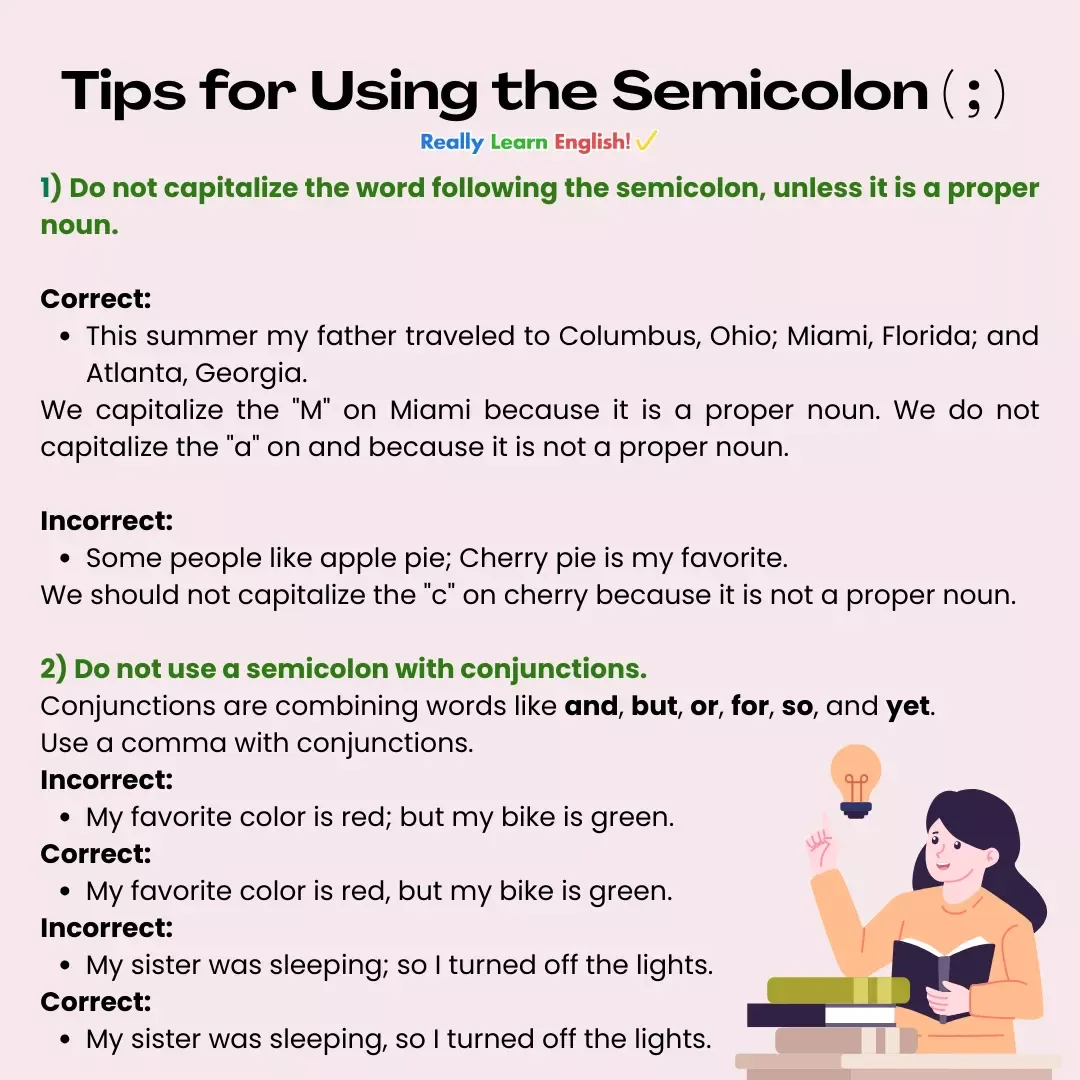
Semicolon Full guide →
Joins two related sentencesThe data is in; the analysis starts Monday. Before however, thereforeSales rose; however, costs rose faster. Splits list items that contain commasLeeds, UK; Lyon, France; and Turin, Italy.
:
Introduces a list after a full sentenceBring three things: ID, a pen and your offer letter. Introduces an explanationOne problem remains: nobody owns the budget.
’
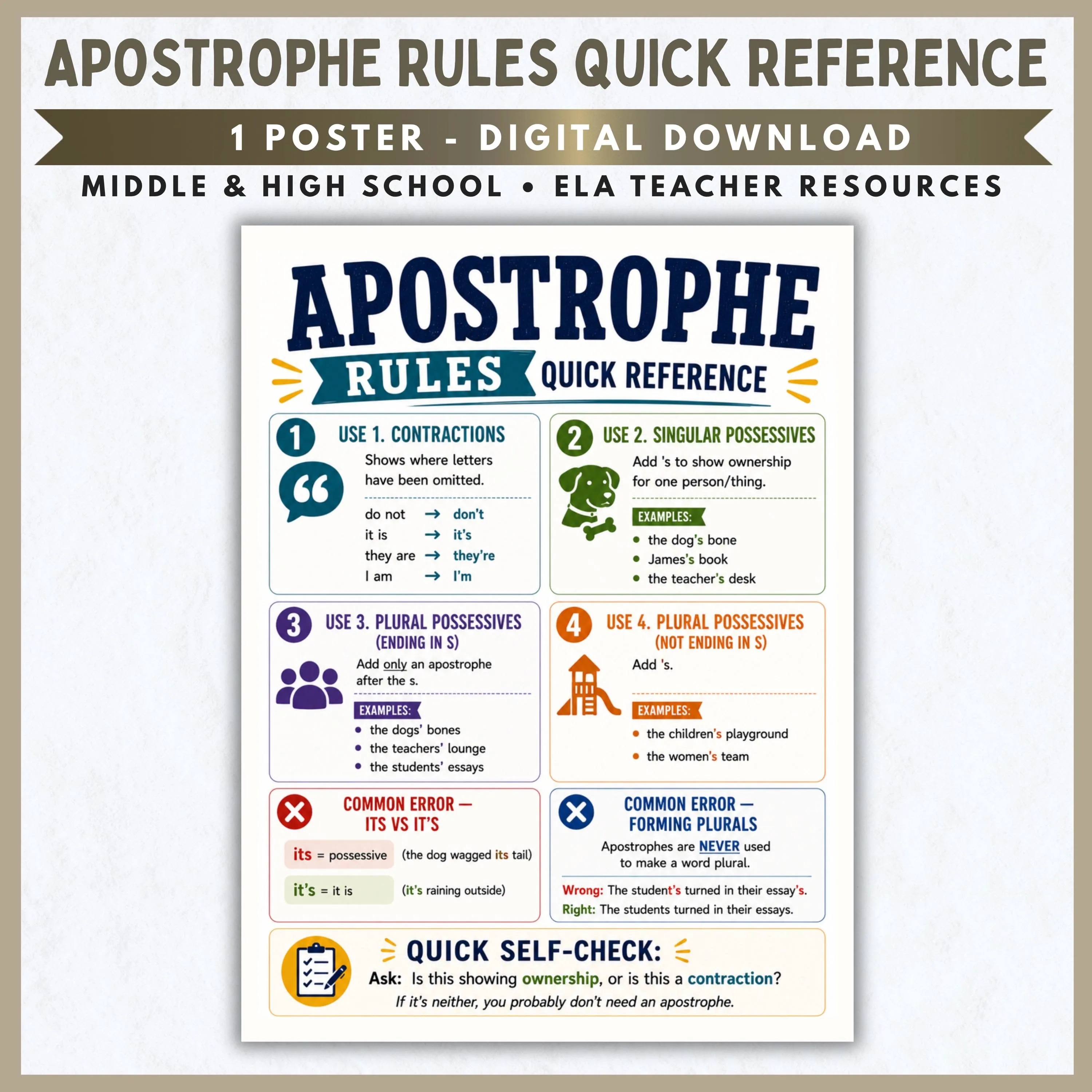
Apostrophe Full guide →
Shows possessionthe client’s file · the clients’ files Marks missing lettersit’s (it is) · don’t (do not)
“ ”
Quotation marks Full guide →
Direct speech and quotesShe said, “We’ll start on Monday.” Titles of short worksRead the article “Writing for Busy Readers”.
Hyphen and dashes Full guide →
Hyphen joins wordsa well-written, two-page memo En dash for ranges; em dash for a breakOpen 9 to 5 · The planif it workssaves weeks.

Commas that change the meaning

Commas around a phrase mark it as extra information: the sentence still identifies who you mean without it. No commas means the phrase is essential: it tells the reader which one. Each pair below is correct, but the two versions say different things.

No commas: essential Staff who worked late got a bonus. Only the staff who worked late got one.
Commas: extra information Staff, who worked late, got a bonus. All the staff worked late, and all got a bonus.
No commas: essential My brother who lives in Leeds is visiting. You have more than one brother; this is the Leeds one.
Commas: extra information My brother, who lives in Leeds, is visiting. You have one brother, and he happens to live in Leeds.
No commas: essential The laptops that were delivered on Monday are faulty. Only Monday’s delivery is faulty.
Commas: extra information The laptops, which were delivered on Monday, are faulty. All the laptops are faulty; Monday is just extra detail.
No commas: essential Let’s eat Grandma’s recipe tonight. Grandma’s recipe is what you will eat.
Commas: extra information Let’s eat, Grandma. A comma before a name shows you are speaking to that person.
The four comma rules that matter most →

How strong is each break?

Commas, semicolons, colons and full stops all mark a pause, but of different strength. Picking the right one is mostly a question of how separate the two ideas are.

Comma , A light pause inside one sentence. After lunch, we met the client.
Dash An informal break for an aside or a twist. We met the clientfinally.
Colon : Stops to deliver what was promised. We met one client: Northwind.
Semicolon ; Joins two full sentences that belong together. We met the client; they signed.
Full stop . Ends the thought completely. We met the client. They signed.

Where the apostrophe goes

Write the owner first, then add the apostrophe. If the owner already ends in s because it is plural, the apostrophe goes after that s.

OwnerRuleExample
One person or thingadd ’sthe manager’s office
A plural ending in sadd ’ after the sthe managers’ offices
A plural without sadd ’sthe children’s books · women’s football
A name ending in sadd ’s (or ’ alone, if your style guide says so)James’s report · James’ report
Two owners sharing one thingadd ’s to the last name onlySam and Lee’s project
Time expressionstreat like ownersa day’s work · two weeks’ notice

British and American punctuation

Both styles are correct. Choose the one your readers expect and use it throughout.

American style
Main quotation marks“double”, with ‘single’ insideFull stops and commasalways inside: She said, “Yes.”Oxford commausual: red, white, and blueAbbreviationsMr. · Dr. · e.g.,
British style
Main quotation marks‘single’, with “double” inside (many publishers)Full stops and commasinside only if part of the quoteOxford commaoptional: red, white and blueAbbreviationsMr · Dr (no full stop) · e.g.

Punctuating bullet points

The rule depends on what each bullet is. Pick one style per list and keep it the same for every item.

Single words or short phrases No punctuation at the end. Start each with a lower-case or capital letter, consistently.
The role includes:
•budgeting•supplier contracts•monthly reporting
Items that finish the lead-in sentence Each item continues the sentence. Many styles end the last item with a full stop.
Before the meeting, please:
•read the agenda•check the figures•bring your laptop.
Full sentences Capital letter at the start and a full stop at the end of every item.
Three changes start in May:
•Invoices will go out weekly.•All expenses need a receipt.•Travel must be booked in advance.

Hyphens in compound adjectives

An adjective is a word that describes a noun (a long report). When two words work together to describe a noun, they form a compound adjective, and a hyphen joins them so the reader takes them as one idea. The hyphen usually appears only when the compound comes before the noun.

PatternBefore the nounAfter the nounWhy
Adjective + nouna long-term plana plan for the long termAfter the noun, the words are ordinary words again.
Number + unita two-page memoa memo of two pagesThe unit stays singular before the noun: two-page, not two-pages.
Adjective + -ing worda good-looking designthe design is good lookingMany style guides drop the hyphen after the verb be.
well + past participlea well-written reportthe report is well writtenA past participle is the verb form after “has”: written, made, known.
-ly adverb + adjectivea highly rated supplierthe supplier is highly ratedNever hyphenate after -ly: the -ly already shows the link.
Three or more wordsan up-to-date listthe list is up to dateHyphenate every word in the compound before the noun.

The hyphen can change meaning: “a small-business owner” owns a small business, while “a small business owner” is a business owner who is small. For the difference between hyphens and the two dashes, see the em dash, en dash and hyphen guide.

Numbers, dates and times

Numbers carry their own punctuation rules, and they differ between countries. Use the left column for British readers and the right for American ones; international documents often use the British forms.

WhatBritishAmericanRule
Thousands12,50012,500A comma every three digits from the right; many styles skip it for four-digit numbers.
Decimals3.5%3.5%A full stop for the decimal point in English (many European languages use a comma).
Full date14 June 2026June 14, 2026American style puts a comma between day and year.
Short date14/06/202606/14/2026Write the month as a word in international documents to avoid confusion.
Time9.30 am or 9:309:30 a.m.British English accepts a full stop or colon; American uses a colon.
Ranges15 to 18 JuneJune 15 to 18En dash, no spaces. Write “from 15 to 18 June”, never “from 15 to 18”.
Money£1,450 · £2.5m$1,450 · $2.5MSymbol before the number, no space.

Ranges such as 9 to 5 and 2025 to 26 take an en dash, the mid-length dash, not a hyphen. A colon separates hours and minutes in both styles, and the colon rules guide covers its other uses in ratios and titles.

One paragraph, every mark explained

This paragraph from a project update uses eight different marks. Each numbered mark has a note giving the rule behind it.

After two weeks of testing,¹ the team found one problem:² the client’s³ payment page loads slowly on older phones.⁴ The fix is simple;⁵ the timing is harder. Priya⁶who built the pagesays it will take three to four days. Her words were, “⁷We can ship it by the 14th.” Testing runs 15⁸18 June.

  1. 1,After an opening phrase (“After two weeks of testing”).
  2. 2:A full sentence promises something; the colon delivers it.
  3. 3’sPossession by one client: add ’s.
  4. 4.Ends a complete statement.
  5. 5;Joins two full sentences that contrast closely.
  6. 6A pair of em dashes around an aside, no spaces in American style.
  7. 7, “ ”A comma introduces the quote; the full stop sits inside because it belongs to the quoted sentence.
  8. 8An en dash for a range of dates.

Marks 5 and 6 are the ones writers reach for least. The semicolon rules for professional writers show when a semicolon reads better than a full stop, and the quotation marks guide covers note 7 in both British and American style.

Check yourself: which mark fills the gap?

Choose a mark for each sentence. The explanation appears once you pick.

The office is closed on Friday ___ it reopens on Monday.
We need three things ___ a venue, a date and a budget.
After the call ___ Priya sent the summary.
The new system ___ if it works ___ will save weeks.
The budget was tight ___ however, we finished on time.
Our CEO ___ who founded the firm in 2009 ___ will speak first.

Guides on punctuation rules

9 guides · newest first
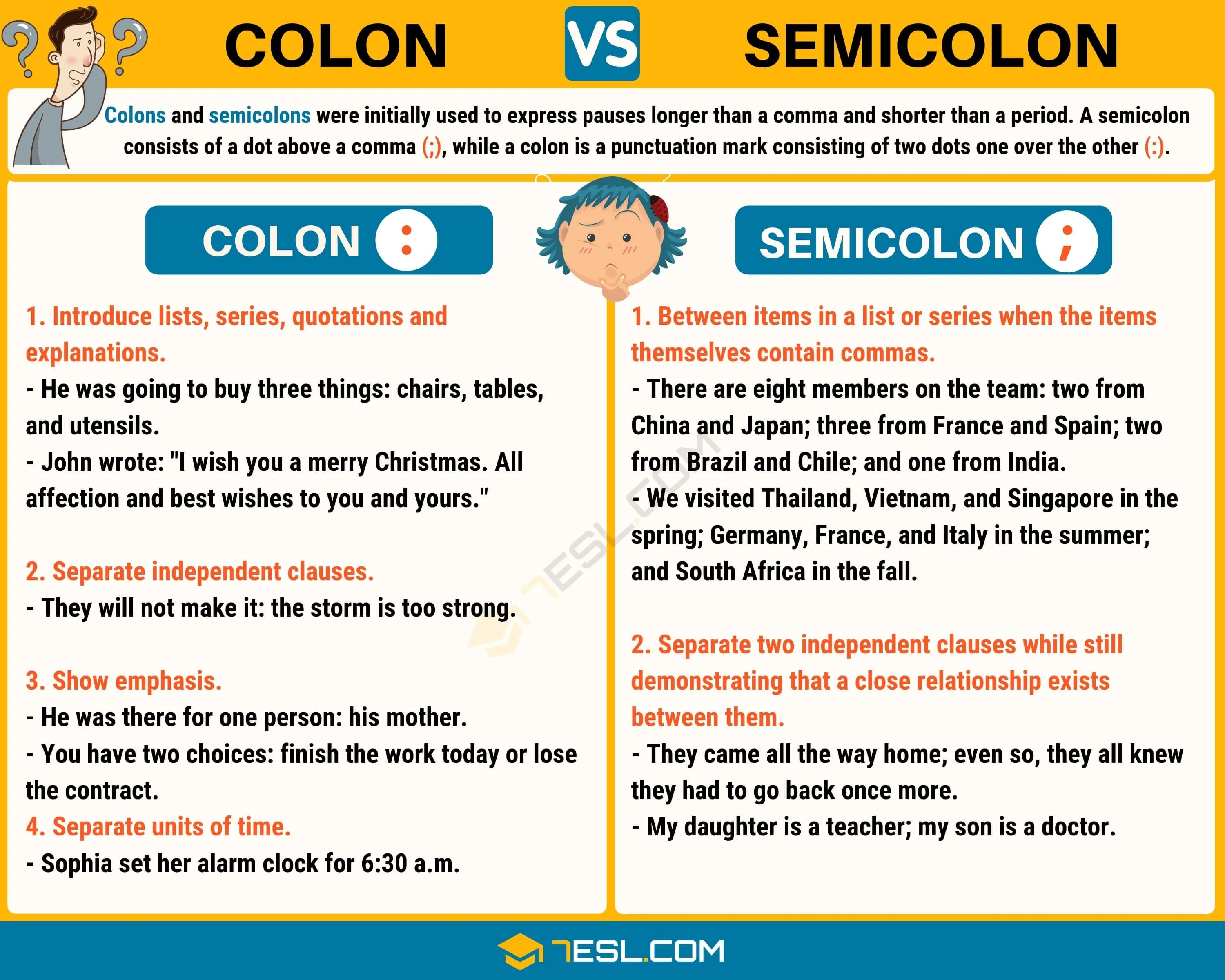
Semicolon Usage: Rules and Examples
Semicolon Usage: Rules and ExamplesMaster the semicolon with clear rules for joining independent clauses, separating complex lists, and using conjunctive adverbs, plus real examples.Apr 23, 2026 · 13 min read
Colon Rules: When and How to Use
Colon Rules: When and How to UseMaster the colon with clear rules for lists, emphasis, quotes, and explanations, 20+ examples, a comparison table with semicolons, and a self-check exercise.Apr 9, 2026 · 9 min read
Em Dash vs En Dash vs Hyphen: Complete Guide
Em Dash vs En Dash vs Hyphen: Complete GuideLearn the difference between hyphen, en dash, and em dash with usage rules, keyboard shortcuts, 20+ examples, and a self-check exercise for writers.Apr 9, 2026 · 13 min read
Quotation Marks Rules: Punctuation Guide
Quotation Marks Rules: Punctuation GuideComplete guide to quotation marks: direct and indirect speech, titles, American vs British style, nested quotes, and 20+ examples for every writing context.Apr 8, 2026 · 9 min read
Semicolon Rules for Effective Writing: A Complete Guide
Semicolon Rules for Effective Writing: A Complete GuideComplete guide to semicolons with the three legitimate uses, common errors, comparison to periods and commas, and register-appropriate usage for professional writers.Apr 8, 2026 · 13 min read
Apostrophe Rules - The Complete Guide to Using Apostrophes
Apostrophe Rules - The Complete Guide to Using ApostrophesMaster every apostrophe rule with clear examples. Covers possessives, contractions, its vs it's, plural rules, and the most common apostrophe mistakes to avoid.Mar 27, 2026 · 18 min read
Mastering Commas: A Comprehensive Guide to Usage
Mastering Commas: A Comprehensive Guide to UsageMaster every comma rule with clear examples. Covers Oxford commas, introductory elements, compound sentences, nonessential clauses, and the most common comma errors.Mar 27, 2026 · 28 min read
Comma Rules Everyone Gets Wrong (and How to Fix Them)
Comma Rules Everyone Gets Wrong (and How to Fix Them)The comma rules that trip up professional writers. Oxford commas, restrictive clauses, compound sentences, and the four rules that fix 80 percent of errors.Mar 27, 2026 · 15 min read
Semicolon Usage: A Guide to Correct Applications
Semicolon Usage: A Guide to Correct ApplicationsLearn when and how to use semicolons correctly. Covers independent clauses, conjunctive adverbs, complex lists, and common semicolon mistakes with clear examples.Mar 27, 2026 · 26 min read