Three scripts, three jobs
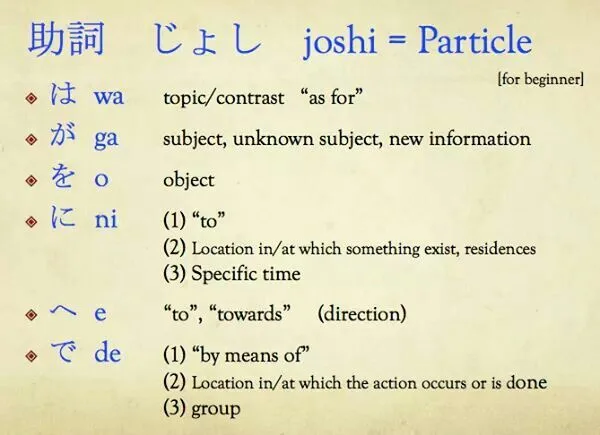
Particles: the labels after each word
A particle is a short word placed after a noun to show its role, like a label. Choose one to see it in a sentence.
Three levels of politeness
Japanese changes the verb itself depending on who you are talking to. Keigo (敬語, “respectful language”) is the formal system used at work and with strangers.
| Level | “I eat” / “Do you eat?” | Used with |
|---|---|---|
| Plain (casual) | 食べる / 食べる?taberu / taberu? | Friends, family, people younger than you |
| Polite (teineigo) | 食べます / 食べますかtabemasu / tabemasu ka | Colleagues, strangers, most everyday situations; the form learners start with |
| Respectful (sonkeigo) | 召し上がります / 召し上がりますかmeshiagarimasu / meshiagarimasu ka | Customers, senior people, formal speech about someone else’s actions |
Word order: the verb comes last
Japanese puts the verb at the end of the sentence, after the object. Linguists call this SOV: subject, object, verb. Because particles mark each word’s job, the words before the verb can move around, but the verb stays last.
Verb groups and the te-form
Every Japanese verb belongs to one of three groups, and the group decides how it changes. Learn the group with each new verb. The te-form, shown in the last column, joins actions together and builds many other forms, so it is the first one most learners practise. Full tables are in the u-verb and ru-verb reference.
| Group | Dictionary form | Polite (masu) | Te-form |
|---|---|---|---|
| Ru-verbs | 食べる taberu, eat | 食べます tabemasu | 食べて tabete |
| U-verbs | 書く kaku, write | 書きます kakimasu | 書いて kaite |
| U-verbs | 飲む nomu, drink | 飲みます nomimasu | 飲んで nonde |
| Irregular | する suru, do | します shimasu | して shite |
| Irregular | 来る kuru, come | 来ます kimasu | 来て kite |
Asking questions with か
To turn a polite statement into a yes/no question, add か ka at the end. The word order does not change, and in writing Japanese often uses no question mark.
Counting things: counters
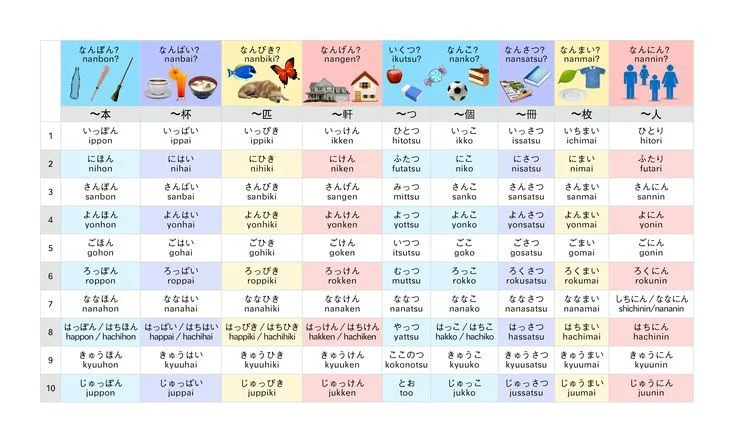
Like Chinese measure words, Japanese counters sit between a number and a noun, and the counter depends on the shape or type of thing. The number sound often changes before a counter. See the counters reference for the full list.
| Counter | Example | Used for |
|---|---|---|
| 枚 mai | 三枚 sanmai, three sheets | Flat things: paper, tickets, shirts |
| 本 hon | 二本 nihon, two bottles | Long, thin things: pens, bottles, trains |
| 人 nin | 三人 sannin, three people | People (but one person is 一人 hitori) |
| 匹 hiki | 一匹 ippiki, one cat | Small animals |
| つ tsu | 三つ mittsu, three things | General counter for objects, up to ten |
How to start learning Japanese
- 1Learn hiragana firstAll 46 signs in one to two weeks. Every other script and word builds on it.
- 2Then katakanaThe same sounds in a second script, used for borrowed words such as テレビ terebi, “TV”.
- 3Learn polite verb formsStart with ます forms: they are safe with everyone and simple to build.
- 4Add kanji slowlyTen a week, always inside words you already know, not as single characters.
- 5Follow the JLPT levelsThe Japanese-Language Proficiency Test has five levels, N5 to N1, which give a clear path to full fluency.
Guides on Japanese grammar and vocabulary
20 guides · newest first