LangLibra.
Browse
About
Grammar guide · Linking ideas

Transition words

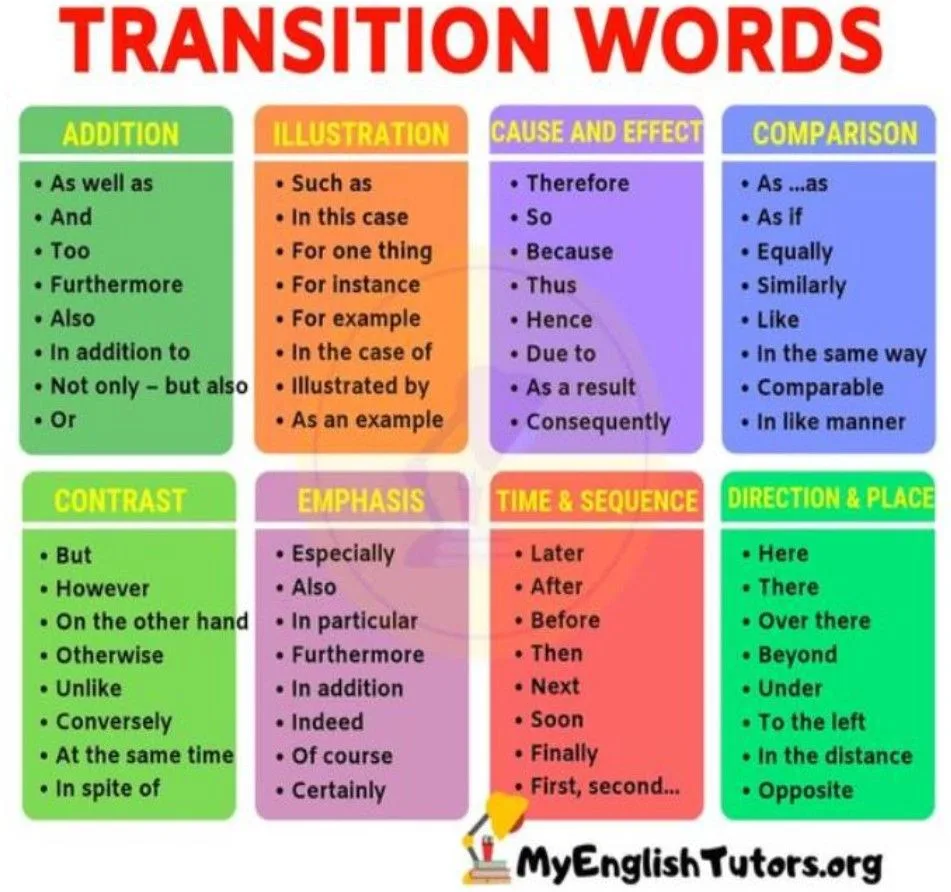
A transition word tells the reader how the next idea relates to the last one: more of the same, a contrast, a result, the next step. Choose by the job it does, then by how formal your document is.

Material costs rose 12% this year. ADDS Moreover, shipping prices doubled. CONTRASTS However, our margins held steady. SHOWS A RESULT As a result, we raised prices.
Same first sentence, three different directions. The transition decides which way the reader expects the paragraph to go.

Transitions by job

Each group runs from everyday to formal. Words marked formal suit reports, academic writing and official letters.

Addingmore of the same idea alsoandplusin additionfurthermoremoreover The tool is faster. In addition, it costs less.
Contrastinga different or opposite point butyetstillhoweverneverthelessconversely Sales fell in May. However, June was our best month.
Cause and effecta reason or a result sobecauseas a resultthereforeconsequentlythus The supplier was late; therefore, we moved the launch.
Sequencesteps or order in time firstthennextafter thatfinallysubsequently First, log in. Next, open the report. Finally, export it.
Examplesshowing a case for examplefor instancesuch aslikenamelyto illustrate Some costs rose sharply, for example energy and rent.
Concludingsumming up sooverallto sum upin shortin conclusionin summary Overall, the pilot met four of its five targets.

How to punctuate a transition

The punctuation depends on where the transition sits and whether it joins two full sentences.

At the start of a sentenceFollow it with a comma. However, the budget was approved.
Joining two full sentencesPut a semicolon before and a comma after. The budget was tight; however, we finished on time.
In the middle of a sentencePut commas on both sides. The budget, however, was approved in full.
Short joining words (and, but, so)Use a comma before them when they join two full sentences. The budget was tight, but we finished on time.

Transitions at work in one paragraph

A paragraph from a project update. Each highlighted word tells the reader what the next sentence will do.

First, we moved all customer queries into one shared inbox. As a result, response times fell from two days to six hours. In addition, fewer queries were lost between teams. However, the inbox became crowded at busy times. Therefore, we now propose adding automatic tagging by topic.

First,sequence: the first stepAs a result,cause and effect: the outcomeIn addition,adding: a second benefitHowever,contrasting: a problemTherefore,cause and effect: the conclusion

Formal and everyday equivalents

The same link in two registers. Use the left column in essays and reports, the right column in emails and conversation.

furthermore↔also
however↔but
therefore↔so
consequently↔as a result
nevertheless↔still
subsequently↔later, then
in addition↔plus
for instance↔like
in conclusion↔all in all
prior to this↔before that

Linking paragraphs, not just sentences

Between paragraphs, a single word is often too small. These phrases recap the last paragraph and point to the next in one move.

Recap and move on With the costs set out, we can turn to the benefits.
Add a further point Beyond cost, the new system also improves security.
Introduce a contrast These gains, however, come with two risks.
Narrow the focus Of these risks, the more serious is data migration.
Give the result The outcome of these changes was a 30% saving.
Lead to the close Taken together, these findings point to one recommendation.

Using fewer, better transitions

A transition is only useful when the link between two sentences is not already obvious. Writers new to formal English often start every sentence with one, which makes the text slower, not clearer. Cut any transition the reader would add in their head anyway.

BeforeFurthermore, the new system is faster. Moreover, it is cheaper. Additionally, staff prefer it. Therefore, we recommend it.
AfterThe new system is faster, cheaper and preferred by staff. We recommend it.

The rewrite keeps one link, the recommendation, and turns the three “and also” transitions into a list.

Pairs that are easy to mix up

although / despite“Although” is followed by a full clause with a verb; “despite” is followed by a noun or an -ing form.Although the train was late, we arrived. / Despite the delay, we arrived.
whereas / whileBoth contrast two facts. “While” can also mean “during the time that”, so use “whereas” when there could be confusion.London grew 4%, whereas Leeds grew 9%.
PairDifferenceExample
besides / beside“Besides” means “in addition”; “beside” means “next to”.Besides the cost, there is the time.
in contrast / on the contrary“In contrast” compares two things; “on the contrary” rejects what was just said.Sales fell in May. In contrast, June was strong.

For the academic set, with register notes, see transition words for academic writing.

Practise in three steps

  1. 1HighlightMark every transition in your last report or essay.
  2. 2Name the jobWrite next to each one what it does: add, contrast, cause, example, order.
  3. 3Cut or swapDelete any the reader would not miss; swap repeats for a different word with the same job.