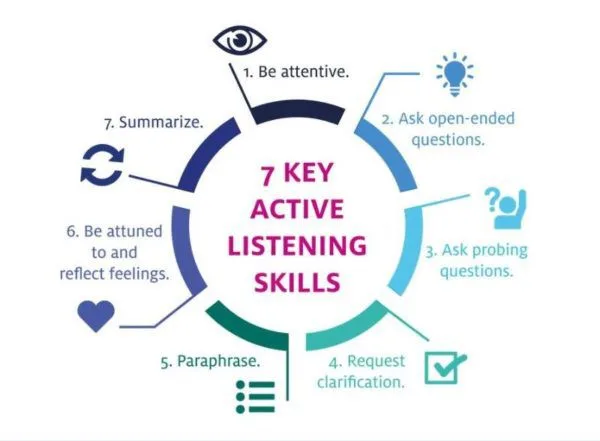
Most professionals think active listening is mainly about staying quiet and nodding at the right moments. Silence and attention matter, but the questions you ask do more to prove you are listening than any amount of eye contact.
A well-timed question shows the other person that you heard them, that you cared enough to follow their logic, and that you want to understand rather than simply reply. This guide breaks down the specific kinds of questions that turn a passive conversation into a genuine exchange.
Why Questions Are the Engine of Active Listening
When you ask a thoughtful question, you signal three things at once. You confirm that you were paying attention, you invite the speaker to say more, and you create space for detail that would otherwise stay hidden. A statement closes a loop. A question keeps it open. That difference is what allows a conversation to move from surface facts to the reasoning and feelings underneath them.
Poor listeners tend to ask questions that serve themselves. They steer toward advice they already want to give, or they interrogate for facts they can act on. Strong listeners ask questions that serve the speaker first. The goal is to help the other person think out loud, not to extract material for your own response.
The Main Types of Listening Questions
Not all questions do the same work. Knowing which type to reach for depends on where the conversation is and what the speaker seems to need.
Clarifying Questions
Clarifying questions remove ambiguity. You use them when a word, a timeline, or a decision is unclear, and getting it wrong would derail everything that follows. Examples include “When you say the launch slipped, do you mean the whole release or just the marketing?” and “Can you walk me through what happened right before that?” These questions are humble by design. They admit that you might have misheard and give the speaker room to correct you.
Probing Questions
Probing questions go one layer deeper into something the speaker has already touched on. They are useful when you sense there is more behind a short answer. “What made that option feel risky to you?” and “What would have to be true for this to work?” both push gently past the first response without putting the person on the defensive.
Reflective Questions
Reflective questions play back what you heard, framed as a check. “So it sounds like the deadline itself was fine, but the last-minute changes were the real problem. Is that right?” This kind of question does two jobs. It confirms your understanding and gives the speaker a chance to refine their own thinking when they hear it summarized.
Open Invitation Questions
Open invitation questions hand control back to the speaker. “What else is on your mind about this?” or “Where would you like to take this next?” These work well near the end of a topic, when you want to make sure nothing important was left unsaid.
Choosing the Right Question at the Right Moment
The table below maps common conversational situations to the type of question that usually fits best.
| Situation | Best question type | Example |
|---|---|---|
| You are unsure what the person means | Clarifying | “Which project are we talking about here?” |
| The answer feels incomplete | Probing | “What was driving that decision?” |
| You want to confirm you understood | Reflective | “It sounds like the cost was the sticking point, yes?” |
| The person seems to have more to say | Open invitation | “Is there anything I am missing?” |
| Emotions are running high | Reflective, then open | “That sounds frustrating. What would help right now?” |
The order matters. Clarifying and reflective questions build safety early. Probing questions land better once that safety exists. Open invitation questions close the loop and hand back control.
Questions to Avoid
Some questions look curious but quietly shut a conversation down. Leading questions like “Don’t you think we should just cancel it?” push the speaker toward your answer rather than their own. Stacked questions, where you fire off three at once, force the person to pick which one to answer and usually lose the other two. Why questions can also backfire when they sound like an accusation. “Why did you do that?” often reads as blame, so “What led you to that choice?” tends to keep the door open.
Closed yes-or-no questions are not wrong, but they end momentum. Use them to confirm a specific fact, then follow with something open if you want the conversation to continue.
Timing and Silence
A good question loses its power if you rush it. Give the speaker a beat to finish their thought before you jump in. When you do ask, resist the urge to fill the pause that follows. Silence after a probing question is not awkward. It is the space in which the real answer forms. Many people reveal their most useful thoughts in the second or third sentence, after the rehearsed first answer runs out.
Watch for tempo as well. Rapid-fire questions feel like an interview or an interrogation. Slower, spaced questions feel like a conversation between equals. If you notice the other person giving shorter and shorter answers, you are probably asking too fast.
Putting It Together in a Real Exchange
Imagine a colleague tells you a project is behind schedule. A weak response is to immediately offer a fix. A strong response walks through the question types in sequence. You clarify with “Behind on which part specifically?” You reflect with “So the design is done but the review keeps getting pushed.” You probe with “What is making the review hard to schedule?” Only then, if the person wants it, do you move toward solutions with “Would it help to think through how to unblock that?”
By the time you reach a suggestion, you understand the actual problem instead of the version you imagined at the start. That is the entire point. Advice given before understanding is usually advice about the wrong problem.
Building the Habit
Active listening questions feel unnatural at first because most of us are trained to prepare our reply while the other person is still talking. The fix is to give yourself one simple rule: before you say anything that is not a question, make sure you have asked at least one that moved the conversation forward. Over time, the habit shifts from something you perform to something you simply do, and the people you talk with notice the difference long before they can name it.
Frequently asked questions
What is the difference between a clarifying and a probing question?
A clarifying question removes ambiguity about something you may have misheard or misunderstood, such as asking which project someone means. A probing question goes deeper into something the speaker has already said, exploring their reasoning or feelings. Clarifying questions keep you accurate, while probing questions keep the conversation moving into useful detail. You usually clarify first to make sure you are on the same page, then probe once you understand the basics.
How do I ask questions without sounding like an interrogation?
Slow down and space your questions out instead of firing several in a row. Mix in reflective statements that show you heard the last answer before you ask the next thing. Avoid stacking multiple questions into one turn, since that forces the person to choose which to answer. A conversational pace and genuine curiosity make questions feel like interest rather than an interview.
Why should I avoid why questions in sensitive conversations?
Why questions often sound like an accusation, especially when emotions are already high, because they can imply the person made a mistake. Someone hearing why did you do that may feel they need to defend themselves rather than explain openly. Rephrasing to what led you to that choice keeps the same curiosity without the blame. This small shift usually keeps the other person engaged instead of defensive.
When should I stop asking questions and offer a solution?
Wait until you clearly understand the real problem and the person signals they are ready to move forward. Rushing to advice before understanding usually means solving the wrong problem, which wastes everyone’s time. A good check is to reflect back what you heard and ask whether they want to explore solutions. If they say yes, you can shift to problem solving with confidence that you understand the situation.