Bengali expresses time through two parallel calendrical systems and a vocabulary of temporal expressions that reflects centuries of cultural layering. The international Gregorian calendar is dominant in administrative and commercial life, but the traditional Bengali calendar (বঙ্গাব্দ Bôngabdo, "the Bengali era") remains active for religious observance, agricultural reckoning, and major cultural festivals.
The Bengali New Year, পহেলা বৈশাখ Pôhela Boishakh, is celebrated as a public holiday in Bangladesh and as a major cultural event throughout West Bengal. A learner who works only with the Gregorian months will miss half of how Bengalis actually experience the rhythm of the year.
This reference assembles the Bengali day-month-time vocabulary in both calendrical systems, with the temporal expressions that bind them together. Each term is presented in Bengali script, in Romanized transliteration, and with English explanation.
The day names and Gregorian month names are essentially uniform across West Bengal and Bangladesh; the Bengali calendar months are also shared but are pronounced with slight regional variations. Time expressions for "yesterday," "today," and "tomorrow" follow patterns that surprise English speakers, in particular the famous ambiguity of কাল kal which means both yesterday and tomorrow depending on context.
A note on cultural context. Bengali time-keeping reflects the agricultural and religious cycles of the delta region. The Bengali calendar months track astronomical seasons that align with the monsoon cycle: the rainy month আষাঢ় Ashaṛh, the autumn month আশ্বিন Ashshin, the winter month পৌষ Poush, each carrying associations of weather, festivals, food, and even mood.
Bengali poetry, including Tagore's, is saturated with month-name references that locate emotional states in particular seasonal moments. For a learner, vocabulary mastery is the gateway to this cultural depth. For deeper background on the Tagore tradition that draws so heavily on the calendar, see the Bengali Tagore Literature reference.
The Days of the Week
Bengali days of the week are derived from Sanskrit and are shared with most other North Indian languages, although the pronunciation differs. Each day is associated with a planetary deity in classical astrology, an association that survives in religious observance even where it is unrecognized in daily speech.
| Bengali | Transliteration | English | Planetary Association |
|---|---|---|---|
| সোমবার | Shombar | Monday | Moon |
| মঙ্গলবার | Môngolbar | Tuesday | Mars |
| বুধবার | Budhbar | Wednesday | Mercury |
| বৃহস্পতিবার | Brihôshpôtibar | Thursday | Jupiter |
| শুক্রবার | Shukrôbar | Friday | Venus |
| শনিবার | Shônibar | Saturday | Saturn |
| রবিবার | Rôbibar | Sunday | Sun |
The suffix -বার -bar means "day" or "occasion" and is shared across all seven names. The roots are Sanskrit planetary names: সোম Shom (moon), মঙ্গল Môngol (Mars), বুধ Budh (Mercury), and so on. The day বৃহস্পতিবার Brihôshpôtibar (Thursday) is so long that informal speech often shortens it to বৃহস্পতি brihôshpôti.
In Bangladesh, the traditional weekend was Friday and Saturday (reflecting the Muslim tradition of Friday as the day of communal prayer), but since September 2005 the government's two-day weekly holiday has been Friday and Saturday.
In West Bengal, the standard weekend is Saturday and Sunday. শুক্রবার Shukrôbar (Friday) carries strong religious associations in Muslim contexts (জুমার নামাজ jumar namaj, the Friday congregational prayer), while রবিবার Rôbibar (Sunday) is the Christian Sabbath and the standard work-free day across India.
Specific days carry religious associations in Bengali Hindu observance: মঙ্গলবার môngolbar (Tuesday) is associated with the goddess Manasa and is favored for snake worship in monsoon; শনিবার shônibar (Saturday) is for the planet-deity Shani; বৃহস্পতিবার brihôshpôtibar (Thursday) is Lakshmi's day, when many households observe a women's vow.
The Gregorian Months
The English month names have been borrowed and Bengali-ized. They are used in administrative, journalistic, and modern commercial contexts.
| Bengali | Transliteration | English |
|---|---|---|
| জানুয়ারি | Januari | January |
| ফেব্রুয়ারি | Phebruari | February |
| মার্চ | March | March |
| এপ্রিল | Êpril | April |
| মে | Me | May |
| জুন | Jun | June |
| জুলাই | Julai | July |
| আগস্ট | Agôsṭ | August |
| সেপ্টেম্বর | Sepṭembôr | September |
| অক্টোবর | Ôkṭobôr | October |
| নভেম্বর | Nôbhembôr | November |
| ডিসেম্বর | Ḍisembôr | December |
These borrowings are unproblematic in business and bureaucratic contexts. A Bengali speaker can equally well say মার্চে march-e (in March) using the borrowed name, or চৈত্রে chôitre (in Choitro) using the traditional Bengali calendar month. Educated speakers shift fluidly between the two, choosing based on the context: bureaucratic forms and modern news take Gregorian; festivals, religious observance, and cultural references take Bengali calendar.
The day-counting system within months is identical to international usage: ১ জানুয়ারি 1 January, ২৫ ডিসেম্বর 25 December. Bengali numerals (১, ২, ৩) are used in formal Bengali writing, while Arabic numerals (1, 2, 3) appear in mixed-language and English-influenced texts. For the full numeral system, see the Bengali Numbers and Counting reference.
The Bengali Calendar Months
The traditional Bengali calendar uses twelve months derived from Hindu astronomy, each named after a constellation (নক্ষত্র nôkkhotro) and aligning with the position of the sun in the zodiac. The Bengali year (বঙ্গাব্দ Bôngabdo) currently runs about 593 years behind the Gregorian, so 2026 CE corresponds to 1432-1433 BS (Bengali Sambat), with 1433 beginning in April 2026.
| Bengali | Transliteration | Approximate Gregorian | Season |
|---|---|---|---|
| বৈশাখ | Boishakh | mid-April to mid-May | Late spring / early summer |
| জ্যৈষ্ঠ | Jôishṭho | mid-May to mid-June | Summer (peak heat) |
| আষাঢ় | Ashaṛh | mid-June to mid-July | Early monsoon |
| শ্রাবণ | Shrabôn | mid-July to mid-August | Monsoon |
| ভাদ্র | Bhadro | mid-August to mid-September | Late monsoon |
| আশ্বিন | Ashshin | mid-September to mid-October | Early autumn |
| কার্তিক | Kartik | mid-October to mid-November | Autumn |
| অগ্রহায়ণ / অঘ্রান | Ôgrohayôn / Ôghran | mid-November to mid-December | Late autumn / harvest |
| পৌষ | Poush | mid-December to mid-January | Winter |
| মাঘ | Magh | mid-January to mid-February | Late winter |
| ফাল্গুন | Phalgun | mid-February to mid-March | Spring |
| চৈত্র | Chôitro | mid-March to mid-April | Late spring |
Each Bengali month has cultural and emotional associations that go beyond mere weather. বৈশাখ Boishakh carries the energy of the new year and festival celebrations; জ্যৈষ্ঠ Jôishṭho is the season of mangoes and lychees; আষাঢ় Ashaṛh ushers in the longed-for monsoon and is the most heavily poeticized month in Bengali literature; শ্রাবণ Shrabôn brings full monsoon and the women's swing-festival ঝুলন jhulôn;
ভাদ্র Bhadro and আশ্বিন Ashshin frame the run-up to Durga Puja; কার্তিক Kartik begins the cool season; অগ্রহায়ণ Ôgrohayôn is the harvest month; পৌষ Poush is winter and marks Pôush Sônkranti; মাঘ Magh is mid-winter and carries ascetic associations; ফাল্গুন Phalgun is spring and the month of the language martyr commemoration in Bangladesh; চৈত্র Chôitro closes the year.
The Bengali calendar's month-names are tied to specific constellations: বৈশাখ Boishakh comes from বিশাখা bishakha (Libra), পৌষ Poush from পুষ্যা pushya (a nakshatra in Cancer), and so on. The astronomical correspondence is approximate after centuries of precession, but the cultural memory remains intact in the names.
Pohela Boishakh and the New Year
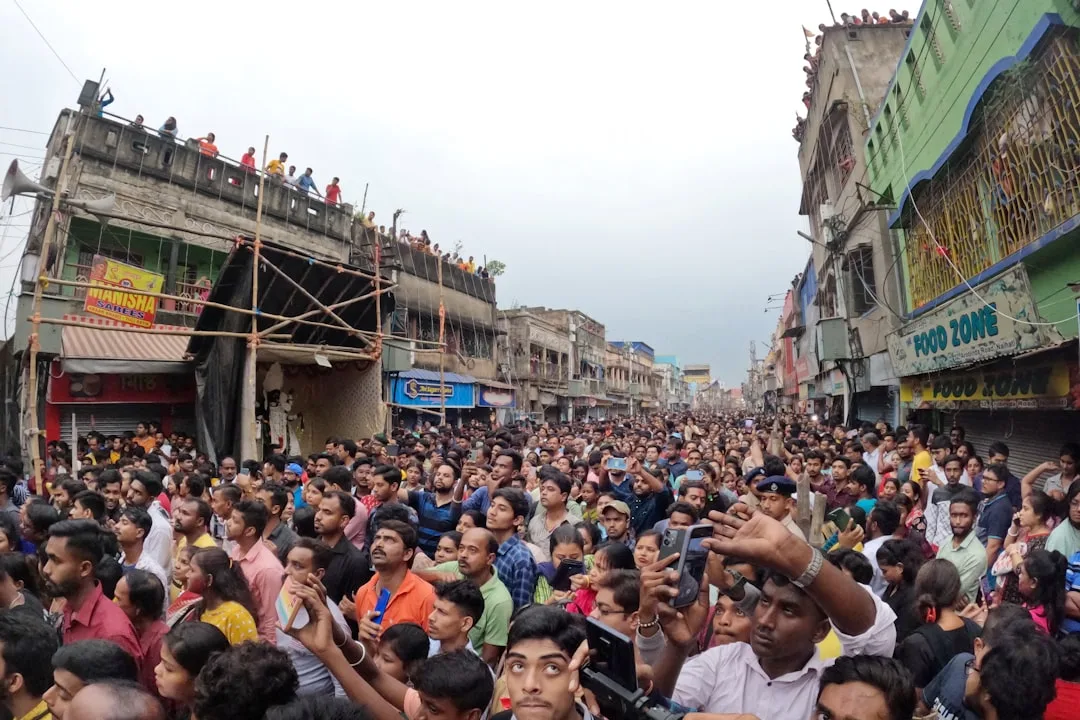
The first day of the Bengali calendar month বৈশাখ Boishakh, পহেলা বৈশাখ Pôhela Boishakh, is the Bengali New Year. It is celebrated on April 14 or 15 in the Gregorian calendar (Bangladesh fixes the date at April 14; West Bengal varies between 14 and 15 based on astronomical calculation). The festival is a major cultural occasion in both regions, with greater public visibility in Bangladesh where it has been actively cultivated as a secular national identity marker since independence.
| Bengali | Transliteration | English |
|---|---|---|
| পহেলা বৈশাখ | Pôhela Boishakh | First of Boishakh, Bengali New Year |
| নববর্ষ | Nôbobôrsho | New Year |
| শুভ নববর্ষ | Shubho nôbobôrsho | Happy New Year |
| মঙ্গল শোভাযাত্রা | Môngol shobhajatra | New Year procession (Bangladesh) |
| হালখাতা | Halkhata | Account-book renewal ceremony |
| পান্তা ভাত | Panta bhat | Fermented overnight rice (festival meal) |
| ইলিশ ভাজা | Ilish bhaja | Fried hilsa (festival meal) |
| বৈশাখী মেলা | Boishakhi mela | New Year fair |
The Bangladeshi celebration features the মঙ্গল শোভাযাত্রা Môngol shobhajatra, a procession originating at Dhaka University with masks, floats, and folk imagery, recognized by UNESCO as a cultural heritage event.
The traditional New Year breakfast পান্তা ভাত panta bhat (rice fermented overnight in water, served with onions, green chilies, and fried hilsa) is consumed across both regions. The merchant tradition of হালখাতা halkhata, in which businesses close old account books and open new ones with offerings to deities and customers, structures the commercial dimension of the festival.
Today, Tomorrow, Yesterday: The কাল kal Puzzle
Bengali handles the relative time vocabulary in a way that confuses English-speaking learners. The word কাল kal means both "yesterday" and "tomorrow," with context determining which. Disambiguation is achieved through tense (a past-tense verb selects "yesterday"), through the prefixes গত gôto (past) or আগামী agami (coming), or through additional context.
| Bengali | Transliteration | English |
|---|---|---|
| আজ | Aj | Today |
| কাল | Kal | Yesterday or tomorrow |
| গতকাল | Gôtokal | Yesterday (explicit) |
| আগামীকাল | Agamikal | Tomorrow (explicit) |
| পরশু | Pôrshu | Day after tomorrow or day before yesterday |
| গত পরশু | Gôto pôrshu | Day before yesterday (explicit) |
| আগামী পরশু | Agami pôrshu | Day after tomorrow (explicit) |
| তরশু | Tôrshu | Three days from now (rare) |
| এ সপ্তাহে | E shôptahe | This week |
| গত সপ্তাহে | Gôto shôptahe | Last week |
| আগামী সপ্তাহে | Agami shôptahe | Next week |
| এ মাসে | E mashe | This month |
| গত মাসে | Gôto mashe | Last month |
| আগামী মাসে | Agami mashe | Next month |
| এ বছর | E bôchhor | This year |
| গত বছর | Gôto bôchhor | Last year |
| আগামী বছর | Agami bôchhor | Next year |
The কাল kal symmetry derives from a Sanskrit root meaning simply "time," with the directional meaning supplied by the linguistic environment. A speaker saying কাল আমি বাজারে গিয়েছিলাম Kal ami bajare giyechhilam (yesterday I went to the market) selects yesterday through the past-tense verb গিয়েছিলাম giyechhilam. A speaker saying কাল আমি বাজারে যাব Kal ami bajare jabo (tomorrow I will go to the market) selects tomorrow through the future-tense verb যাব jabo.
Beginners can avoid the ambiguity by always using the explicit forms গতকাল gôtokal (yesterday) and আগামীকাল agamikal (tomorrow). Native speakers use bare কাল kal in contexts where the tense or additional information eliminates ambiguity.
Telling the Time
Bengali time-of-day vocabulary uses a 12-hour conceptual frame, with day-part qualifiers (সকাল shôkal morning, দুপুর dupur midday, বিকেল bikel afternoon, সন্ধ্যা shondhya evening, রাত rat night) supplementing the numerical hour.
| Bengali | Transliteration | English |
|---|---|---|
| সকাল | Shôkal | Morning |
| দুপুর | Dupur | Noon, midday |
| বিকেল | Bikel | Afternoon |
| সন্ধ্যা | Shondhya | Evening |
| রাত | Rat | Night |
| ভোর | Bhor | Pre-dawn |
| রাত্রি | Ratri | Night (literary) |
| ঘড়ি | Ghôri | Clock, watch |
| ঘণ্টা | Ghônṭa | Hour |
| মিনিট | Miniṭ | Minute |
| সেকেন্ড | Sekenḍ | Second |
| কয়টা বাজে? | Kôyṭa baje? | What time is it? |
| তিনটে বাজে | Tinṭe baje | It is three o'clock |
| সাড়ে তিনটে | Shaṛe tinṭe | Half past three |
| পৌনে চারটে | Poune charṭe | Quarter to four (literally three-quarters of four) |
| সওয়া তিনটে | Shôowa tinṭe | Quarter past three |
The fractional time forms are unusual: সাড়ে shaṛe means "and a half"; পৌনে poune means "quarter to" (literally three-quarters of); সওয়া shôowa means "and a quarter." A Bengali speaker saying সাড়ে তিনটে shaṛe tinṭe means 3:30; পৌনে চারটে poune charṭe means 3:45; সওয়া তিনটে shôowa tinṭe means 3:15. These same forms appear in Hindi-Urdu and other North Indian languages.
The day-part qualifier locates the hour: সকাল আটটা shôkal aṭṭa is 8 AM, রাত আটটা rat aṭṭa is 8 PM, দুপুর একটা dupur êkṭa is 1 PM. Strict 24-hour notation appears in train schedules, military communication, and digital displays, but conversational Bengali always uses the 12-hour form with day-part.
Time Periods and Cycles
The longer time-period vocabulary covers minutes through millennia and includes culturally specific terms.
| Bengali | Transliteration | English |
|---|---|---|
| মুহূর্ত | Muhurtto | Moment |
| ক্ষণ | Khôn | Instant |
| পল | Pôl | A short while |
| মিনিট | Miniṭ | Minute |
| ঘণ্টা | Ghônṭa | Hour |
| প্রহর | Prôhor | Three-hour watch (eight per day, traditional) |
| দিন | Din | Day |
| রাত | Rat | Night |
| সপ্তাহ | Shôptaho | Week |
| পক্ষ | Pôkkho | Fortnight (lunar half-month) |
| মাস | Mash | Month |
| ঋতু | Ritu | Season |
| বছর / বর্ষ | Bôchhor / Bôrsho | Year |
| দশক | Dôshok | Decade |
| শতাব্দী | Shôtabdi | Century |
| সহস্রাব্দ | Shôhôshrabdo | Millennium |
| যুগ | Jug | Era, age |
The traditional eight প্রহর prôhor of the Hindu calendrical day, each three hours long, surfaces in Bengali poetry and devotional contexts but rarely in daily speech. The word পক্ষ pôkkho denotes the half of the lunar month, with শুক্ল পক্ষ shukla pôkkho (the bright half, waxing moon) and কৃষ্ণ পক্ষ krishno pôkkho (the dark half, waning moon) tracking ritual observance.
Common Mistakes English Speakers Make
Translating কাল kal automatically as "yesterday." It means whatever the tense and context indicate. Beginners should use গতকাল gôtokal (yesterday) and আগামীকাল agamikal (tomorrow) until comfortable with the ambiguity.
Confusing দুপুর dupur and বিকেল bikel. দুপুর dupur is midday, roughly 11 AM to 2 PM; বিকেল bikel is afternoon, roughly 3 to 6 PM. The dividing point is around 2 to 3 PM. Saying বিকেল ১২টা bikel 12 ṭa (afternoon 12) is incoherent.
Mispronouncing সাড়ে shaṛe. The retroflex ড় is a flapped sound, not the same as ড dô. The form is heard in clocks, money amounts, and ages: সাড়ে তিন বছর shaṛe tin bôchhor (three and a half years).
Mixing Bengali and Gregorian month names without clear context. বৈশাখে boishakhe and এপ্রিলে aprile both work but reach different audiences. Bengali calendar months are favored in cultural-religious contexts; Gregorian months in administrative-modern contexts.
Forgetting the day-part qualifier. The bare time তিনটে tinṭe (three) is ambiguous between 3 AM and 3 PM. Always specify সকাল shôkal, দুপুর dupur, বিকেল bikel, সন্ধ্যা shondhya, or রাত rat.
Using English ordinals for dates. The Bengali way is cardinal: ১ মার্চ êk march, not প্রথম মার্চ prôthom march (which would mean "first March," like a name). The exception is পহেলা pôhela in পহেলা বৈশাখ Pôhela Boishakh, where the form is fixed.
Miscounting the Bengali year. The Bengali calendar runs 593 years behind the Gregorian, with the new year in mid-April. Year 1432 BS corresponds to April 2025 to April 2026 CE. Adding or subtracting incorrectly is a common foreigner error.
Quick Reference
The minimum time vocabulary: আজ aj (today), কাল kal (yesterday/tomorrow), গতকাল gôtokal (yesterday), আগামীকাল agamikal (tomorrow), সকাল shôkal (morning), দুপুর dupur (midday), বিকেল bikel (afternoon), রাত rat (night), কয়টা বাজে? Kôyṭa baje? (what time?), the days সোমবার-রবিবার Shombar-Rôbibar, and the Gregorian months জানুয়ারি-ডিসেম্বর Januari-Ḍisembôr.
For cultural fluency, learn at least the Bengali month names with their seasonal associations (বৈশাখ spring/new year, আষাঢ় monsoon, পৌষ winter), plus the festival vocabulary পহেলা বৈশাখ Pôhela Boishakh and নববর্ষ nôbobôrsho. Use গতকাল and আগামীকাল explicitly until comfortable with the bare কাল ambiguity.
See Also
- Bengali Numbers and Counting 1 to 1000
- Bengali Tagore Literature and Language Reference
- Bengali Weather, Seasons, and Nature Vocabulary
- Bengali Common Phrases for Daily Conversation
- Bengali Verb Conjugation Complete Tense System
- Bengali Greetings and Phrases for Daily Conversation
- Bengali Dialects: Bangladesh vs West Bengal
Author: Kalenux Team
Frequently asked questions
Why does কাল kal mean both yesterday and tomorrow?
The Sanskrit root कल kala means time generically without a directional specification. Bengali inherited this generic meaning and relies on tense and context for direction. Past-tense verbs select yesterday; future-tense verbs select tomorrow; the explicit prefixes গত gôto and আগামী agami remove doubt.
Is the Bengali calendar still used in everyday life?
For administrative and commercial use, Gregorian dominates. The Bengali calendar remains active for religious festivals, life-cycle ceremonies, agricultural reckoning, business account-book renewal at New Year, and cultural commemoration. Educated Bengalis know both systems.
How is পহেলা বৈশাখ Pôhela Boishakh celebrated?
In Bangladesh, with the Mongol Shobhajatra procession at Dhaka University, public concerts, traditional panta-ilish breakfast, and Boishakhi mela fairs. In West Bengal, with cultural performances, halkhata account renewal, traditional meals, and family visits. Children wear new red-and-white clothes.
What is the difference between দুপুর dupur and বিকেল bikel?
দুপুর dupur is midday, roughly 11 AM to 2 PM, the hottest part of the day. বিকেল bikel is afternoon, roughly 3 to 6 PM, when businesses reopen and tea is served. The transition is around 2 to 3 PM.
Why does Bengali use সাড়ে shaṛe and পৌনে poune for fractional time?
These are inherited from Sanskrit-Persian fractional vocabulary used across North India. সাড়ে shaṛe (and a half), পৌনে poune (quarter to), and সওয়া shôowa (and a quarter) are productive prefixes attaching to whole-hour numbers.
How do I write a date in Bengali?
For modern administrative use: ১৫ এপ্রিল ২০২৬, day-month-year order. For traditional cultural use: ১ বৈশাখ ১৪৩৩ বঙ্গাব্দ, day-month-year. Either form is acceptable; mixing the two systems within one date is unusual.
What is a প্রহর prôhor?
A traditional unit of three hours, with eight প্রহর filling a 24-hour day. They are named for time of day and surface in classical poetry, devotional songs, and religious almanacs. In modern conversation প্রহর is rare but may appear in literary contexts.