One of the first things learners discover about Mandarin Chinese is that it is a tonal language. Unlike English, where tone of voice carries emotional meaning (sounding excited, skeptical, or bored), in Mandarin the pitch pattern on a syllable determines the actual meaning of the word. Say the same sound with the wrong pitch, and you say something entirely different from what you intended.
This is, understandably, one of the most intimidating aspects of Chinese for beginners. The thought that the same syllable "ma" could mean mother, hemp, horse, or scold depending on how you pronounce it seems daunting. But here is what experienced learners and teachers consistently report: tones become natural with practice. The human voice is remarkably adaptable, and what feels awkward and artificial at first becomes effortless after months of listening and speaking.
Mandarin Chinese has four main tones plus a neutral (fifth) tone. Each tone has a precise pitch contour - a shape that your voice traces on the syllable. Linguists describe these contours using a five-point scale, where 1 is the lowest pitch and 5 is the highest. Understanding this system helps you grasp why each tone sounds the way it does.
This guide walks through all five tones with detailed descriptions, visual patterns, tone marks, and - most importantly - dozens of examples showing how tone changes meaning. The guide also covers tone sandhi (the way tones change when combined), common mistakes, and strategies for mastering tones efficiently.
The Five Tones of Mandarin
Tone 1: High Level (First Tone)
Tone mark: macron above the vowel - ā, ē, ī, ō, ū, ǖ (example: ā)
Pitch pattern: High and level, sustained at the top of your range (pitch level 5-5)
Description: Hold your voice at a high, steady pitch, like the sound "aaah" a doctor asks you to make, but pitched high.
Examples:
- 妈 (mā) = "mother"
- 书 (shū) = "book"
- 飞 (fēi) = "to fly"
- 天 (tiān) = "sky / heaven / day"
- 高 (gāo) = "tall / high"
- 花 (huā) = "flower"
- 猫 (māo) = "cat"
- 喝 (hē) = "to drink"
Tone 2: Rising (Second Tone)
Tone mark: acute accent - á, é, í, ó, ú, ǘ (example: á)
Pitch pattern: Rises from mid to high (pitch level 3-5)
Description: Your voice rises sharply, like the intonation in English when you say "What?" or "Really?" with surprise.
Examples:
- 麻 (má) = "hemp / numb / sesame"
- 学 (xué) = "to study"
- 来 (lái) = "to come"
- 年 (nián) = "year"
- 人 (rén) = "person"
- 钱 (qián) = "money"
- 时 (shí) = "time"
- 白 (bái) = "white"
Tone 3: Dipping / Low (Third Tone)
Tone mark: caron above the vowel - ǎ, ě, ǐ, ǒ, ǔ, ǚ (example: ǎ)
Pitch pattern: Dips from mid to low, then rises (pitch level 2-1-4); in isolation or at the end of a phrase
Description: Your voice starts at mid pitch, drops to the lowest point, then rises. In flowing speech before another syllable, it often just dips low without the final rise (this is called the "half third tone").
Examples:
- 马 (mǎ) = "horse"
- 你 (nǐ) = "you"
- 好 (hǎo) = "good"
- 我 (wǒ) = "I / me"
- 水 (shuǐ) = "water"
- 买 (mǎi) = "to buy"
- 走 (zǒu) = "to walk / to leave"
- 手 (shǒu) = "hand"
Tone 4: Falling (Fourth Tone)
Tone mark: grave accent - à, è, ì, ò, ù, ǜ (example: à)
Pitch pattern: Falls sharply from high to low (pitch level 5-1)
Description: A sharp, decisive drop - like saying "No!" or giving a command in English. Confident and abrupt.
Examples:
- 骂 (mà) = "to scold"
- 去 (qù) = "to go"
- 再 (zài) = "again"
- 是 (shì) = "to be"
- 大 (dà) = "big"
- 看 (kàn) = "to look / to watch"
- 要 (yào) = "to want / to need"
- 爱 (ài) = "to love"
Neutral Tone (Fifth Tone / Tone 0)
Tone mark: No mark, or sometimes shown as a dot above
Pitch pattern: Short, light, unstressed - the pitch is determined by the preceding syllable
Description: A short, weak syllable with no fixed pitch. Common in particles and certain suffixes.
Examples:
- 吗 (ma) = question particle (yes/no questions)
- 呢 (ne) = question particle (follow-up questions)
- 吧 (ba) = suggestion/assumption particle
- 的 (de) = possessive/attributive particle
- 了 (le) = completion aspect marker
- 着 (zhe) = ongoing aspect marker
- 们 (men) = plural suffix for pronouns
The Ma Family: How Tone Changes Everything
The syllable "ma" is the classic example showing how tone transforms meaning entirely. These four words are pronounced with identical consonants and vowels - only the pitch differs.
| Character | Pinyin | Tone | Meaning |
|---|---|---|---|
| 妈 | mā (1st) | High level | mother |
| 麻 | má (2nd) | Rising | hemp / numb / sesame |
| 马 | mǎ (3rd) | Dipping | horse |
| 骂 | mà (4th) | Falling | to scold |
| 吗 | ma (neutral) | Short/light | question particle |
The famous sentence that demonstrates all four tones: 妈妈骑马,马慢,妈妈骂马。(Māma qí mǎ, mǎ màn, māma mà mǎ.) = "Mother rides the horse; the horse is slow; mother scolds the horse."
30 Minimal Pairs Showing Tone Meaning Changes
Minimal pairs are pairs of words that differ only in tone. Studying them trains your ear to distinguish tones and your mouth to produce them correctly.
| Pinyin Pair | Characters | Meanings | Tones |
|---|---|---|---|
| mǎi / mài | 买 / 卖 | to buy / to sell | 3rd / 4th |
| wèn / wěn | 问 / 吻 | to ask / to kiss | 4th / 3rd |
| shì / shí | 是 / 时 | to be / time | 4th / 2nd |
| hē / hé | 喝 / 和 | to drink / and | 1st / 2nd |
| duì / duī | 对 / 堆 | correct / pile | 4th / 1st |
| kàn / kǎn | 看 / 砍 | to look / to chop | 4th / 3rd |
| xī / xǐ | 西 / 洗 | west / to wash | 1st / 3rd |
| tiān / tián | 天 / 填 | sky / to fill in | 1st / 2nd |
| zǒu / zòu | 走 / 奏 | to walk / to play (music) | 3rd / 4th |
| bāo / báo | 包 / 薄 | bag / thin | 1st / 2nd |
| jī / jǐ | 鸡 / 几 | chicken / how many | 1st / 3rd |
| tāng / táng | 汤 / 糖 | soup / sugar | 1st / 2nd |
| guò / guō | 过 / 锅 | to pass / pot | 4th / 1st |
| huā / huà | 花 / 画 | flower / to draw | 1st / 4th |
| zhī / zhǐ | 知 / 纸 | to know / paper | 1st / 3rd |
Tone Marks: The Pinyin Marking System
Pinyin uses diacritical marks to indicate tones on vowels. These marks appear above the main vowel in each syllable.
Which vowel gets the tone mark?
When a syllable has only one vowel, the mark goes on that vowel: mā, lè, nǐ.
When there are multiple vowels, follow this priority order:
- a or e always takes the mark (wherever they appear): hǎo, měi, lèi
- ou - mark goes on o: hòu
- Otherwise, the mark goes on the last vowel: guì, duì, kuī
Examples of tone marks in practice:
- 1st tone: ā (macron) = 妈 (mā, mother)
- 2nd tone: á (acute) = 麻 (má, hemp)
- 3rd tone: ǎ (caron) = 马 (mǎ, horse)
- 4th tone: à (grave) = 骂 (mà, to scold)
For multi-vowel syllables:
- 好 (hǎo, good) - mark on a, not o
- 美 (měi, beautiful) - mark on e, not i (a/e rule)
- 贵 (guì, expensive) - mark on i (last vowel rule when no a/e)
Tone Sandhi: How Tones Change in Combination
Tones do not always remain the same when syllables combine into words and sentences. These systematic changes are called tone sandhi.
"Tone sandhi is not an exception to the rules - it is a natural phonological process that makes Mandarin easier to pronounce fluently. The changes follow consistent patterns that become automatic with practice."
The Two Third Tones Rule
The most important sandhi rule: when two third-tone syllables occur in sequence, the first one changes to second tone.
- 你好 (ni hao) - written 3rd + 3rd, but pronounced 2nd + 3rd: ni (rising) hao
- 也许 (ye xu) = "maybe" - pronounced ye (2nd) xu (3rd)
- 所有 (suo you) = "all / every" - pronounced suo (2nd) you (3rd)
- 可以 (ke yi) = "can / may" - pronounced ke (2nd) yi (3rd)
- 买马 (mai ma) = "buy a horse" - mai changes from 3rd to 2nd tone
When three or more third tones occur in a row, the changes depend on natural phrasing boundaries, but generally all but the final one shift to second tone.
不 (bu) Tone Change
不 is normally 4th tone (falling). But before another 4th-tone syllable, 不 changes to 2nd tone (rising):
- 不是 (bu shi) = "is not" - bu becomes 2nd tone before 4th-tone 是
- 不去 (bu qu) = "not going" - bu becomes 2nd tone before 4th-tone 去
- 不要 (bu yao) = "don't want" - bu becomes 2nd tone before 4th-tone 要
- 不吃 (bu chi) = "don't eat" - bu stays 4th before 1st-tone 吃
- 不来 (bu lai) = "not coming" - bu stays 4th before 2nd-tone 来
一 (yi) Tone Changes
一 (yī, "one") is 1st tone in isolation, when counting, or in ordinal numbers (such as 第一 dì-yī, "first"). Before a following syllable, it changes tone:
- Before 4th tone: changes to 2nd tone - 一个 (yí gè, "one [item]") and 一件 (yí jiàn, "one [piece]") - yī becomes 2nd tone (yí)
- Before 1st, 2nd, or 3rd tone: changes to 4th tone - 一天 (yì tiān, "one day"), 一年 (yì nián, "one year"), 一本 (yì běn, "one [volume]") - yī becomes 4th tone (yì)
Tone Pairs: Common Two-Syllable Combinations
Understanding how tones combine helps you prepare for the natural rhythm of Chinese speech.
| Tone Combination | Example | Pinyin | Meaning |
|---|---|---|---|
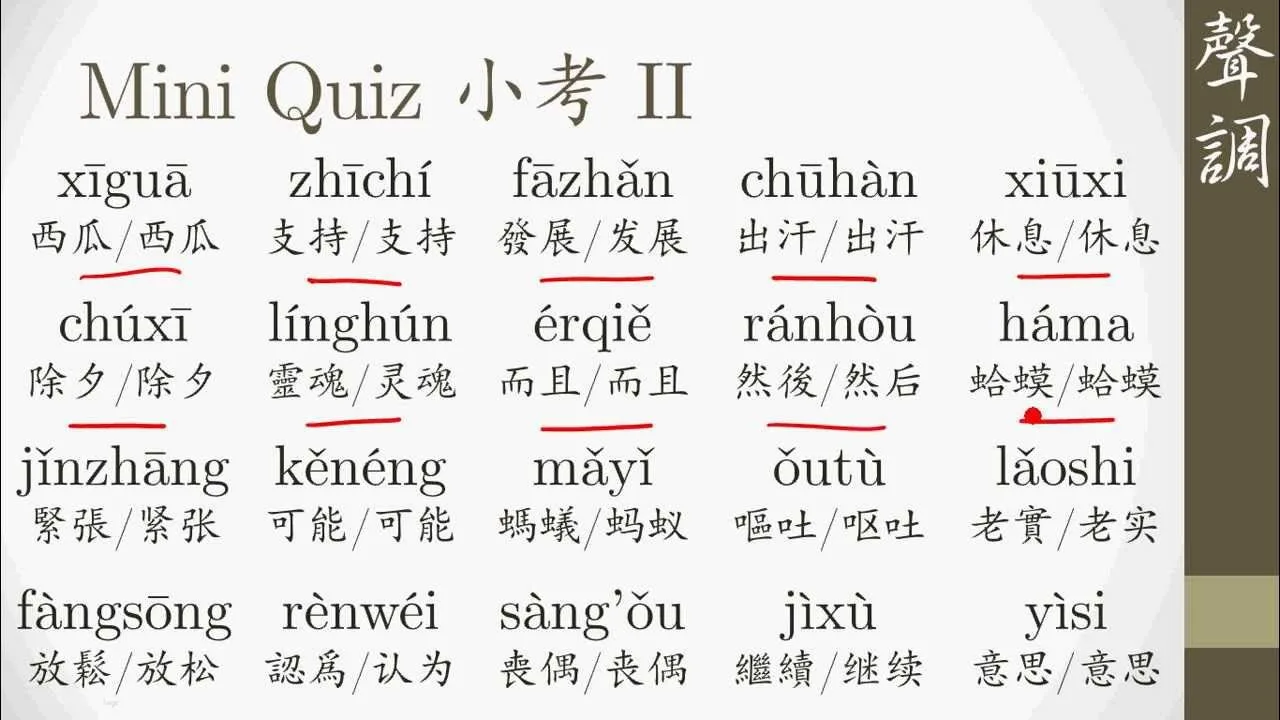
| 1st + 1st | 今天 | jīntiān | today |
| 1st + 2nd | 中国 | Zhōngguó | China |
| 1st + 3rd | 开始 | kāishǐ | to start |
| 1st + 4th | 书店 | shūdiàn | bookstore |
| 2nd + 1st | 明天 | míngtiān | tomorrow |
| 2nd + 2nd | 同学 | tóngxué | classmate |
| 2nd + 3rd | 学好 | xué hǎo | to learn well |
| 2nd + 4th | 学院 | xuéyuàn | college / institute |
| 3rd + 1st | 好吃 | hǎochī | delicious |
| 3rd + 2nd | 你来 | nǐ lái | you come (half-3rd + 2nd) |
| 3rd + 3rd | 你好 | nǐ hǎo | hello (sandhi: ní hǎo) |
| 3rd + 4th | 考试 | kǎoshì | exam |
| 4th + 1st | 唱歌 | chànggē | to sing |
| 4th + 2nd | 问题 | wèntí | question |
| 4th + 3rd | 电影 | diànyǐng | movie |
| 4th + 4th | 再见 | zàijiàn | goodbye |
Common Tone Mistakes and How to Fix Them
"The most common tone error among beginners is not mishearing the tones - it is not listening for them at all. Many learners initially process Chinese the same way they process English, filtering for consonants and vowels and ignoring pitch. Training yourself to hear pitch as a primary signal is the first step."
Mistake 1: Treating All Tones as Equal
Many beginners treat Chinese as if it were an unstressed, monotone language, giving every syllable roughly the same flat pitch. This makes speech almost incomprehensible to native speakers.
Fix: Exaggerate your tones in the beginning. Your 1st tone should feel almost uncomfortably high. Your 4th tone should feel like a sharp, confident drop. Your 3rd tone should feel like a dramatic dip. Native speakers will not think you sound strange - they will think you sound like a serious learner.
Mistake 2: Confusing 2nd and 3rd Tones
The rising second tone and the rising end of the third tone are easy to conflate. Both rise - but the second tone rises from mid to high, while the third tone first dips down before rising.
Fix: Practice pairs like 来 (lai, 2nd) versus 买 (mai, 3rd). The 3rd tone feels like a valley - it must go down before it comes up.
Mistake 3: Applying Tones Inconsistently
A learner might pronounce 你好 correctly when practicing in isolation but revert to flat pronunciation in connected speech.
Fix: Practice full sentences and phrases from day one, not just isolated words. The tones must become automatic at sentence speed.
Mistake 4: Ignoring Tone Sandhi
Learners who memorize that 你 is 3rd tone may insist on pronouncing 你好 with two dipping tones, which native speakers find unnatural.
Fix: Learn common words and phrases with their actual spoken pronunciation, including sandhi: 你好 is learned as "ni (2nd) hao (3rd)."
Mistake 5: Over-stressing Neutral Tone Syllables
Some beginners, anxious about tones, give full tonal weight to every syllable including neutral tone particles like 吗, 的, and 了. This creates a stilted, robotic rhythm.
Fix: Neutral tone syllables should be quick and light. Let them be swallowed into the phrase rather than stressed.
Practical Strategies for Learning Tones
Shadowing: Listen to a native speaker and repeat immediately, mimicking not just the words but the pitch contour of every syllable. Shadowing builds tonal muscle memory faster than any other method.
Tone drills with minimal pairs: Drill pairs like 买 (mai, buy) and 卖 (mai, sell), 问 (wen, ask) and 吻 (wen, kiss) until distinguishing them is instant and effortless.
Record yourself: The gap between how you think you sound and how you actually sound can be large. Recording and comparing yourself to native audio exposes tone errors you might not hear in real time.
Use tones in vocabulary learning: Never learn a Chinese word without learning its tone. A tone is not an optional extra - it is part of the word itself. 买 without knowing it is 3rd tone is not a word you know.
"Think of tone as part of the word, not as a quality added on top. When you learn the word for 'mother' in Chinese, you are learning 'ma-first-tone' as a single unit, just as inseparably as you learn the consonants and vowels."
30 Tone Examples with Context Sentences
Each sentence below illustrates words with tones that commonly trip up learners.
- 妈妈 很 好。(Mama hen hao.) = "Mother is very well." - 1st + 1st, then 2nd + 3rd (sandhi)
- 我 买 了 一 本 书。(Wo mai le yi ben shu.) = "I bought a book." - 3rd, 3rd tone (sandhi: wo 2nd); 一 becomes yì before 本 (3rd)
- 你 去 哪里?(Ni qu nali?) = "Where are you going?" - 3rd, 4th
- 她 是 我 的 朋友。(Ta shi wo de pengyou.) = "She is my friend." - 1st, 4th, 3rd
- 我 不 是 学生。(Wo bu shi xuesheng.) = "I am not a student." - bu becomes 2nd (sandhi)
- 这 本 书 很 贵。(Zhe ben shu hen gui.) = "This book is very expensive." - 4th, 3rd
- 他 学 中文 学 了 两 年。(Ta xue Zhongwen xue le liang nian.) = "He has studied Chinese for two years."
- 我 喜欢 喝 茶。(Wǒ xǐhuan hē chá.) = "I like drinking tea." - 喝茶 (hē chá) is 1st + 2nd
- 今天 天气 很 好。(Jintian tianqi hen hao.) = "Today the weather is good."
- 你 好 吗?(Ni hao ma?) = "How are you?" - sandhi: ni 2nd + hao 3rd
- 我 来 自 美国。(Wo lai zi Meiguo.) = "I come from America." - 2nd, 4th
- 她 买 了 很 多 东西。(Ta mai le hen duo dongxi.) = "She bought a lot of things."
- 他 问 我 一 个 问题。(Ta wen wo yi ge wenti.) = "He asked me a question."
- 你 喜欢 什么 颜色?(Ni xihuan shenme yanse?) = "What color do you like?"
- 我 要 喝 水。(Wo yao he shui.) = "I want to drink water." - 3rd, 4th, 1st, 3rd
- 这 条 路 很 长。(Zhe tiao lu hen chang.) = "This road is very long."
- 她 唱 歌 很 好听。(Ta chang ge hen haoting.) = "Her singing is very pleasant." - 4th, 1st
- 我 们 的 老师 很 严格。(Women de laoshi hen yange.) = "Our teacher is very strict."
- 他 骑 马 很 厉害。(Ta qi ma hen lihai.) = "He rides horses very skillfully."
- 你 什么 时候 来?(Ni shenme shihou lai?) = "When are you coming?"
- 我 最 喜欢 冬天。(Wo zui xihuan dongtian.) = "I like winter the most." - 4th, 1st
- 那 个 地方 很 美。(Nage difang hen mei.) = "That place is very beautiful."
- 书 店 在 哪里?(Shūdiàn zài nǎlǐ?) = "Where is the bookstore?" - 1st, 4th, 4th, 3rd, 3rd (nǎlǐ is pronounced ná-lǐ by sandhi)
- 我 可以 用 一下 吗?(Wo keyi yong yixia ma?) = "May I use it for a moment?" - sandhi: ke 2nd
- 他 不 去 学校。(Ta bu qu xuexiao.) = "He is not going to school." - bu 2nd (sandhi)
- 中 文 很 难 学。(Zhōngwén hěn nán xué.) = "Chinese is difficult to learn." - 1st, 2nd, 3rd, 2nd, 2nd
- 你 的 名字 怎么 写?(Ni de mingzi zenme xie?) = "How do you write your name?"
- 我 昨天 买 了 很 多 书。(Wo zuotian mai le hen duo shu.) = "Yesterday I bought many books."
- 这 个 颜色 很 漂亮。(Zhege yanse hen piaoliang.) = "This color is very beautiful."
- 你 每天 几点 起床?(Ni meitian ji dian qichuang?) = "What time do you get up every day?"
Quick Reference: Tone Summary Cheat Sheet
| Tone | Mark | Pitch Contour | Mnemonic | Example |
|---|---|---|---|---|
| 1st | macron (ā) | High and level (5-5) | Holding a high, flat note | 妈 mā = mother |
| 2nd | acute (á) | Rising from mid to high (3-5) | Asking "What?" in surprise | 麻 má = hemp |
| 3rd | caron (ǎ) | Dips then rises (2-1-4) | Valley shape, like "Oh really?" | 马 mǎ = horse |
| 4th | grave (à) | Sharp fall from high to low (5-1) | Giving a command: "No!" | 骂 mà = to scold |
| Neutral | none | Short, light, unstressed | Swallowed quickly | 吗 ma = question particle |
Conclusion
Mandarin tones are one of the most distinctive features of the language, and they are also one of the most learnable. Every sound in the tonal system follows consistent rules. The four pitch contours - high level, rising, dipping, and falling - are well-defined and reproducible with practice. The sandhi rules that modify tones in combination are systematic and predictable.
What makes tones click for learners is not memorization of abstract rules but repeated, attentive exposure and production. Listen carefully, imitate precisely, and record yourself often. Within months, what once felt like an impossible balancing act will start to feel like second nature. The tones are not the wall between you and Chinese fluency - they are a door, and this guide has given you the key.
Frequently asked questions
How long does it take to master Chinese tones?
Most learners achieve consistent, intelligible tones within three to six months of regular practice. Full mastery - producing tones automatically without conscious thought - typically takes one to two years of active use.
Can I be understood if I get tones wrong?
Context helps a great deal in many situations. But in ambiguous contexts, wrong tones cause real communication failures. Tones are not optional decoration - they are part of each word’s identity.
What is tone sandhi in Chinese?
Tone sandhi refers to systematic changes that occur when certain tones are combined. The most important rule: when two third-tone syllables follow each other, the first changes to second tone. Ni hao is pronounced with a rising tone on ni, not a dipping tone.
Are tones as important in casual speech as in formal speech?
Tones are equally important in all registers of Mandarin Chinese. While some syllables may be reduced in very fast speech, overall tonal accuracy matters in all situations and contexts.
Do all Chinese dialects use the same four tones?
No. Mandarin uses four tones plus a neutral tone. Cantonese has six tones, and many Southern Chinese dialects have five or more. The four tones in this guide apply specifically to Mandarin (Putonghua).
What is the best way to practice Chinese tones?
Shadowing native speakers is the most effective method - listen and repeat immediately, mimicking pitch patterns exactly. Recording yourself and comparing to native audio also exposes errors that are hard to catch in real time.
Q: How long does it take to master Chinese tones?
A: Most learners achieve consistent, intelligible tones within three to six months of regular practice. Full mastery - producing tones automatically without conscious thought - typically takes one to two years of active use.
Q: Can I be understood if I get tones wrong?
A: Context helps a great deal. In a restaurant, mispronouncing "soup" (tang, 1st tone) as "sugar" (tang, 2nd tone) will not cause confusion because you are clearly ordering food. But in ambiguous contexts, wrong tones cause real communication failures.
Q: Are tones as important in casual speech as in formal speech?
A: Tones are equally important in all registers. However, in very fast, colloquial speech, some syllables get reduced to neutral tone that textbook material might not show. Overall tonal precision matters in all situations.
Q: Do all Chinese dialects use the same four tones?
A: No. Mandarin uses four tones plus neutral. Cantonese has six tones. Many Southern Chinese dialects have five or more. The four tones described in this guide apply specifically to Mandarin (Putonghua / Standard Chinese).
Q: Is it true that native speakers sometimes cannot understand each other because of tone errors?
A: Native speakers rarely have this problem with each other. But non-native speakers with inconsistent tones can be very difficult for native speakers to understand, particularly on the phone or in noisy environments where context cues are fewer.