Adjectives are the part of Spanish speech that foreign learners most often mis-agree, mis-position, and misuse - because Spanish adjectives, unlike their English counterparts, change form to match the gender and number of the noun they describe, and because the position of an adjective (before or after the noun) can change meaning. This Spanish Colors reference collects the forms, examples, and usage notes in one place.
This reference focuses on colors and the most frequent adjectives, demonstrates the rules of agreement, shows how position affects nuance, and lays out the vocabulary for describing people, objects, and places. Colors are the most visible and drilled kind of adjective, so they anchor the presentation: la casa roja (the red house) is a model for every other adjective pattern.
Color adjectives demonstrate the basic agreement rule cleanly. Rojo (masculine singular) becomes roja (feminine singular), rojos (masculine plural), and rojas (feminine plural) to match el libro rojo, la casa roja, los libros rojos, las casas rojas. A few colors - verde, azul, marron, gris - change only in number, not gender.
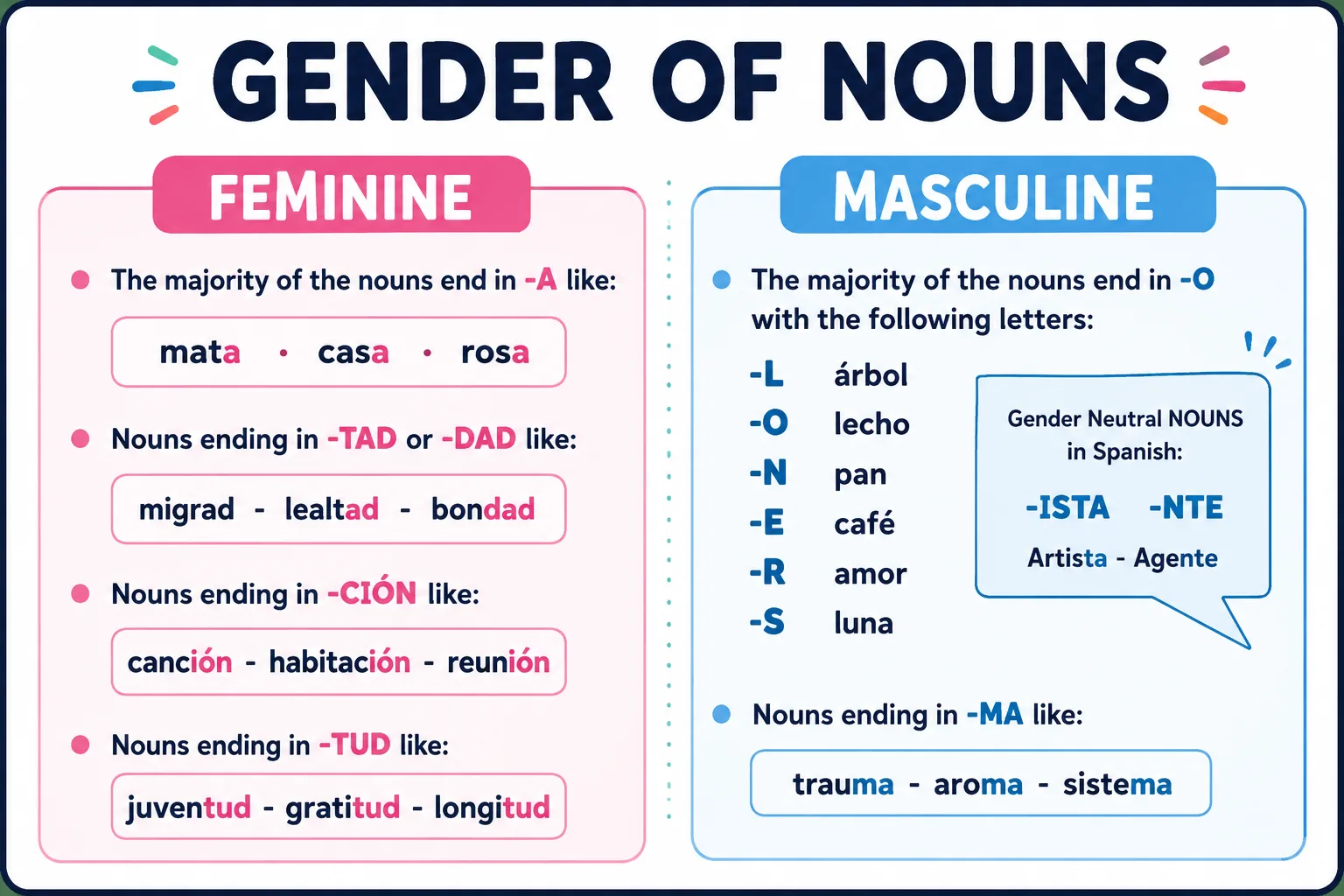
A few more - rosa, naranja, lila, violeta - derived from flowers or fruits, do not change at all in formal usage. This reference marks these classes explicitly. For the grammar of gender and agreement, see the Spanish gender of nouns reference and the Spanish grammar rules guide.
The Basic Colors
Table 1. Colors with full gender/number forms.
| Base | Feminine | Plural m | Plural f | English |
|---|---|---|---|---|
| rojo | roja | rojos | rojas | red |
| amarillo | amarilla | amarillos | amarillas | yellow |
| negro | negra | negros | negras | black |
| blanco | blanca | blancos | blancas | white |
| morado | morada | morados | moradas | purple |
These colors end in -o and follow the basic four-form pattern.
Table 2. Colors invariant in gender.
| Color | Plural | English |
|---|---|---|
| verde | verdes | green |
| azul | azules | blue |
| gris | grises | gray |
| marron | marrones | brown |
| cafe | cafes | brown (LatAm) |
| beige | beiges | beige |
Colors ending in -e, -l, or a consonant change only in number. La casa verde, los coches verdes. Note that cafe for brown is used in most of Latin America instead of marron, which is standard in Spain.
Table 3. Colors from flowers and fruits (invariant).
| Color | English | Source |
|---|---|---|
| rosa | pink | la rosa (rose) |
| naranja | orange | la naranja (orange) |
| lila | lilac | la lila (lilac) |
| violeta | violet | la violeta (violet) |
| turquesa | turquoise | la turquesa (turquoise stone) |
These do not agree in gender or number in formal usage: las flores rosa, los coches naranja. In casual speech, some speakers add plural -s (coches naranjas), but the invariant form is the safer standard. The RAE (Royal Spanish Academy) accepts either.
Rule of thumb: if the color name is also the name of an object (rose, orange, violet, turquoise), treat it as invariant - you are saying "rose-colored," not "rose." Grammatically it is elliptical for de color rosa. This logic blocks gender agreement.
More Specific Color Vocabulary
Table 4. Intermediate colors.
| Spanish | English |
|---|---|
| claro | light (modifier) |
| oscuro | dark (modifier) |
| dorado / dorada | gold |
| plateado / plateada | silver |
| azul claro | light blue |
| azul marino | navy blue |
| verde claro / verde oscuro | light green / dark green |
| rojo oscuro | dark red |
| rosa palido | pale pink |
| rosa vivo | hot pink |
| pastel | pastel |
| neon | neon |
When a color is modified (azul claro, verde oscuro), neither part agrees with the noun: los coches azul oscuro, not los coches azules oscuros. The entire compound color becomes invariant. This trips beginners up because "azul" alone would otherwise agree for number.
Agreement Rules in Detail
The four-form rule. An adjective ending in -o in the dictionary form has four agreement forms:
| Form | Ending | Example with rojo |
|---|---|---|
| Masculine singular | -o | el coche rojo |
| Feminine singular | -a | la casa roja |
| Masculine plural | -os | los coches rojos |
| Feminine plural | -as | las casas rojas |
The two-form rule. An adjective ending in -e or a consonant has two forms - singular and plural - and does not change for gender:
| Form | Ending | Example with verde |
|---|---|---|
| Singular (m/f) | -e | el coche verde / la casa verde |
| Plural (m/f) | -es | los coches verdes / las casas verdes |
The invariant rule. Adjectives derived from nouns (especially colors from flowers/fruits) do not change: la camisa rosa, los zapatos rosa.
Position: Before or After the Noun
Spanish adjectives most commonly follow the noun they describe: un libro interesante, una casa grande, un coche rojo. But a handful of adjectives have meaningful positions - and some change meaning depending on position.
Table 5. Adjectives whose position changes meaning.
| Adjective | After noun (literal) | Before noun (figurative) |
|---|---|---|
| grande | un hombre grande (a big man) | un gran hombre (a great man) |
| pobre | una mujer pobre (a poor woman, without money) | una pobre mujer (a pitiful woman) |
| viejo | un amigo viejo (an elderly friend) | un viejo amigo (a long-time friend) |
| nuevo | un coche nuevo (brand-new car) | un nuevo coche (a different car) |
| antiguo | una casa antigua (an old/ancient house) | una antigua casa (a former house) |
| solo | una mujer sola (a woman who is alone) | una sola mujer (only one woman) |
This doubling is one of the most elegant distinctions in Spanish. Un gran hombre praises his character; un hombre grande describes his size. Un viejo amigo is one you have known for years; un amigo viejo is elderly.
Inexperienced learners translate "my new car" as mi nuevo coche, but that means "my different car" (I traded up). For a factory-fresh car, say mi coche nuevo. The "before" position for nuevo implies a change in circumstance; the "after" position implies literal newness.
General guidance on position.
- After the noun (default). Most adjectives in most situations: una casa grande, una pelicula buena, un examen dificil. Use this when describing, distinguishing, or classifying.
- Before the noun (stylistic or idiomatic). A handful of very common adjectives - bueno, malo, grande, pequeno - often precede the noun in stock phrases: un buen amigo, un mal dia, una gran oportunidad. This position can feel more literary or emphasize an inherent quality.
Apocopation. Some adjectives lose their final vowel when they precede a masculine singular noun:
| Full | Apocopated | Example |
|---|---|---|
| bueno | buen | un buen libro |
| malo | mal | un mal hombre |
| grande | gran | un gran amigo (m or f) |
| primero | primer | el primer dia |
| tercero | tercer | el tercer piso |
| alguno | algun | algun dia |
| ninguno | ningun | ningun problema |
Grande apocopates to gran before any singular noun (not just masculine): una gran mujer, un gran hombre. The others only apocopate before masculine singular.
Adjectives for Describing People
Table 6. Personality and character.
| Spanish | English |
|---|---|
| amable | kind |
| simpatico / simpatica | nice, likeable |
| antipatico / antipatica | unpleasant |
| inteligente | intelligent |
| tonto / tonta | silly / dumb |
| divertido / divertida | fun |
| aburrido / aburrida | boring |
| serio / seria | serious |
| alegre | cheerful |
| triste | sad |
| timido / timida | shy |
| valiente | brave |
| cobarde | cowardly |
| generoso / generosa | generous |
| egoista | selfish |
| trabajador / trabajadora | hard-working |
| perezoso / perezosa | lazy |
| honesto / honesta | honest |
| sincero / sincera | sincere |
Note aburrido is a notorious adjective because its meaning depends on whether it takes ser or estar: ser aburrido = to be a boring person; estar aburrido = to be bored at this moment. See the ser vs estar guide for the fuller logic.
Table 7. Physical appearance.
| Spanish | English |
|---|---|
| alto / alta | tall |
| bajo / baja | short |
| delgado / delgada | thin |
| gordo / gorda | fat |
| fuerte | strong |
| debil | weak |
| guapo / guapa | good-looking |
| bonito / bonita | pretty |
| feo / fea | ugly |
| joven | young |
| viejo / vieja | old |
| moreno / morena | dark-haired / dark-skinned |
| rubio / rubia | blond |
| pelirrojo / pelirroja | redheaded |
| calvo / calva | bald |
Moreno/a has a broad range: it can describe dark hair, dark skin, or a suntan, depending on context. In some Latin American countries it is used warmly for darker-skinned people. In Cuba, trigueno is sometimes preferred. Pelirrojo literally means "red-haired" (pelo + rojo).
Table 8. Age and stage of life.
| Spanish | English |
|---|---|
| joven | young |
| mayor | elderly / older |
| adulto / adulta | adult |
| nino / nina | child |
| adolescente | teenager |
| anciano / anciana | elder (respectful) |
Mayor is the polite word for an older person: una persona mayor (an older person). Viejo is more blunt and can sound rude. Anciano is formally respectful.
Describing Places and Things
Table 9. Adjectives for places and things.
| Spanish | English |
|---|---|
| grande | big |
| pequeno / pequena | small |
| largo / larga | long |
| corto / corta | short |
| ancho / ancha | wide |
| estrecho / estrecha | narrow |
| alto / alta | high / tall |
| bajo / baja | low / short |
| caro / cara | expensive |
| barato / barata | cheap |
| bueno / buena | good |
| malo / mala | bad |
| limpio / limpia | clean |
| sucio / sucia | dirty |
| nuevo / nueva | new |
| viejo / vieja | old |
| moderno / moderna | modern |
| antiguo / antigua | ancient |
Quantity, Intensity, and Comparison
Table 10. Intensifiers and quantifiers.
| Spanish | English |
|---|---|
| muy | very |
| poco | a little |
| bastante | enough / quite |
| demasiado | too much |
| mucho | a lot |
| algo | somewhat |
| nada | nothing / not at all |
| tan | so |
| tanto | so much |
Comparative forms.
- mas + adjective + que = more... than: mas alto que (taller than)
- menos + adjective + que = less... than: menos caro que (less expensive than)
- tan + adjective + como = as... as: tan bueno como (as good as)
Superlatives.
- el mas + adjective (+ de) = the most: el mas alto (the tallest)
- el menos + adjective = the least
- -isimo/a = absolute superlative: altisimo (extremely tall), buenisimo (extremely good)
Irregular comparatives.
| Base | Comparative |
|---|---|
| bueno | mejor (better) |
| malo | peor (worse) |
| grande | mayor (bigger/older) |
| pequeno | menor (smaller/younger) |
Common Mistakes
- Failing to agree color in gender. La casa rojo is wrong; it must be la casa roja.
- Over-agreeing invariant colors. La camisa rosas is wrong; rosa does not add -s in formal usage.
- Putting all adjectives before the noun. English "the red car" is "el coche rojo" in Spanish (after the noun). Reversing this sounds poetic or changes meaning.
- Mixing un gran and un grande. Before any singular noun, use gran. Before a plural noun, use grandes. Un hombre grande is literal size; un gran hombre is greatness.
- Using ser aburrido to mean "I'm bored." That means "I'm a boring person." Use Estoy aburrido for "I'm bored right now."
- Not apocopating bueno/malo/primero/tercero. Un bueno libro is wrong; un buen libro is correct.
- Agreeing the second part of compound colors. Los coches azul oscuros is wrong; both parts stay invariant (los coches azul oscuro).
Quick Reference Cheat Sheet
The 10 essential colors. rojo (red), azul (blue), verde (green), amarillo (yellow), negro (black), blanco (white), gris (gray), marron/cafe (brown), rosa (pink), naranja (orange).
Color agreement rules.
- -o colors: four forms (rojo/roja/rojos/rojas)
- -e or consonant colors: two forms (verde/verdes, azul/azules)
- Flower/fruit colors: invariant (rosa, naranja, lila)
- Modified colors: invariant (azul claro)
Adjective position.
- Default: after the noun (una casa grande)
- Before the noun: changes meaning or adds emphasis (un gran hombre, un buen amigo)
Apocopation. buen(o), mal(o), gran(de), primer(o), tercer(o), algun(o), ningun(o) - drop the final vowel before a masculine singular noun; gran also applies to feminine singular.
See Also
- Spanish gender of nouns rules and exceptions
- Spanish grammar rules complete beginners guide
- Ser vs estar complete guide with examples
- Spanish verb conjugation system -AR -ER -IR reference
- Spanish common phrases for daily conversation
- Spanish alphabet pronunciation guide
- Spanish pronouns direct indirect object reflexive
- Spanish por vs para complete usage reference
Frequently asked questions
Why does rojo become roja?
Spanish adjectives agree in gender and number with the noun they modify. Rojo is masculine singular; roja is feminine singular; rojos is masculine plural; rojas is feminine plural.
Why does rosa not change but roja does?
Rosa is a noun (rose) used as a color adjective (‘rose-colored’). Such adjectives, being elliptical for de color X, do not agree. Other invariant colors include naranja, lila, violeta, turquesa.
When does the adjective go before the noun?
Default position is after the noun (una casa grande). Some adjectives (bueno, malo, grande, primero, nuevo, viejo) precede the noun in stock phrases or when meaning shifts from literal to figurative: un hombre grande (big) vs un gran hombre (great).
How do I say 'a good friend'?
Un buen amigo (apocopated before masculine singular) or un gran amigo (for emphasis). Una buena amiga (no apocope for feminine). Un amigo bueno is grammatical but less idiomatic.
Is brown marron or cafe?
Both. Marron is standard in Spain; cafe (from the color of coffee) is standard in most of Latin America. Both are understood everywhere.
How do I make a comparative and superlative?
Comparative: mas/menos + adjective + que. Equality: tan + adjective + como. Superlative: el/la mas + adjective + de, or -isimo/a (altisimo, buenisimo).
Why does gran apply to feminine nouns but buen does not?
A historical quirk. Grande apocopates to gran before any singular noun (un gran hombre, una gran mujer). Bueno apocopates to buen only before masculine singular (un buen libro).