Color terminology in Swahili sits at the intersection of two systems that the language brings together. The first system is the indigenous Bantu set of color stems: -ekundu (red), -eusi (black), -eupe (white), and a small number of others, all of which take agreement prefixes that change with the noun class of the noun they describe.
The second system is borrowed: kahawia (brown), samawati (blue), bluu (blue, English), pinki (pink), kijivu (gray), and the constructions with -a (of) such as -a kijani (green, of greenness) and -a manjano (yellow, of turmeric). The mixed system reflects Swahili's history as a coastal trading language that absorbed words from Arabic, Portuguese, and English while keeping its Bantu grammatical core.
A learner of Swahili needs to understand both halves of the color system to read a market, a clothing label, a description of livestock, or a poem. Colors do not work like English colors.
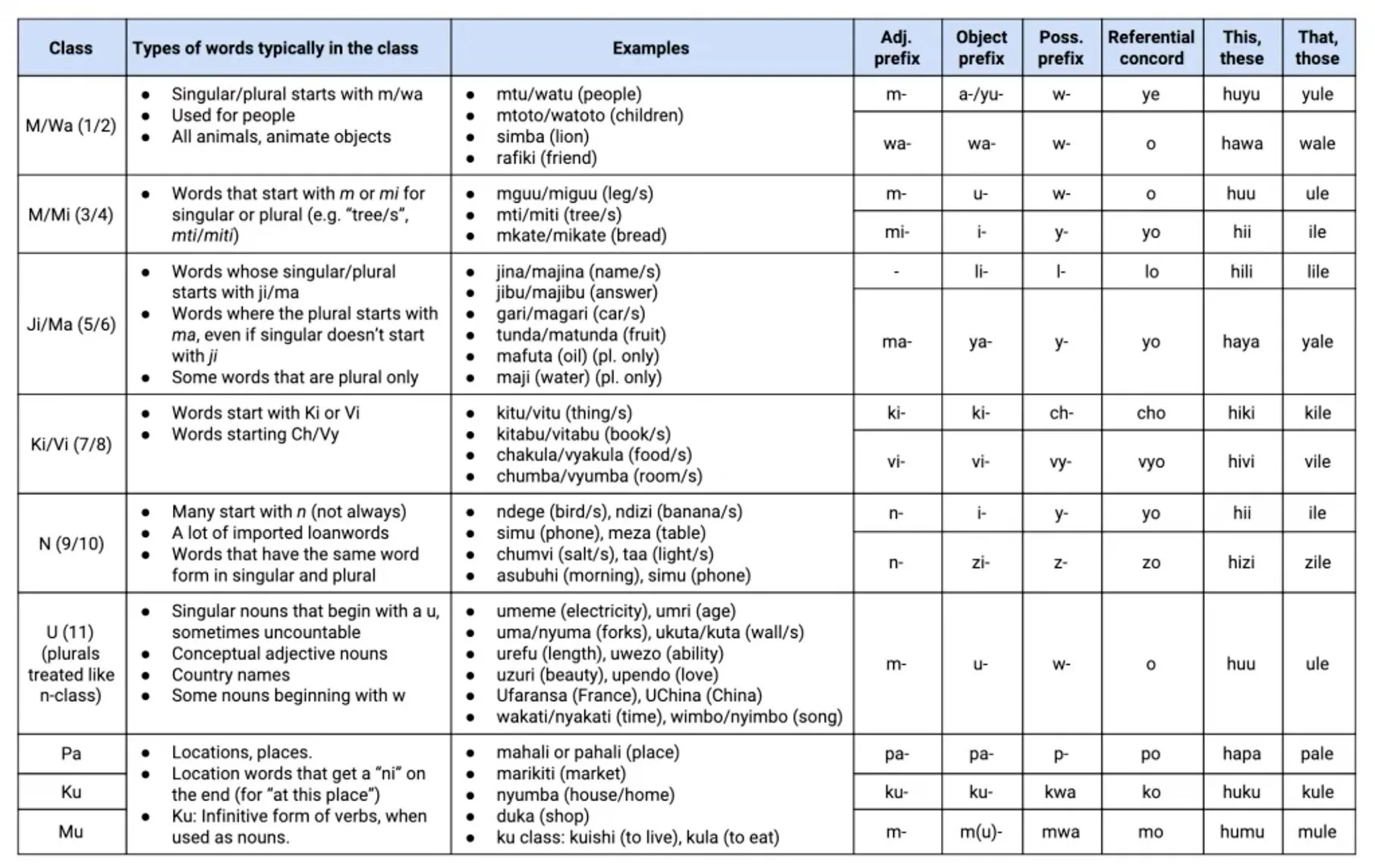
The Swahili word for red is nyekundu when applied to a class 9 noun like nyumba (house), mwekundu when applied to a class 1 noun like mtu (person), kiekundu (or chekundu) when applied to a class 7 noun like kitabu (book), and so on. The same color word takes a different prefix every time it modifies a different kind of noun.
This reference catalogs the basic colors of Swahili, the noun-class agreement patterns that govern most Bantu color stems, the loan colors that escape agreement, and a wider set of descriptive adjectives covering size, shape, age, and quality.
It also covers comparative and superlative formation, the order of adjectives in a noun phrase, and a small set of color-related cultural notes. The aim is to make a reader competent both in describing what they see and in understanding how Swahili color and adjective vocabulary fits into the broader noun-class system.
The Six Native Color Stems
| Stem | Meaning |
|---|---|
| -ekundu | red |
| -eusi | black |
| -eupe | white |
| -ekundu mweusi | dark red, deep red |
| -a kijani | green (of greenness) |
| -a manjano | yellow (of turmeric) |
Three of these (-ekundu, -eusi, -eupe) are true Bantu adjective stems with agreement prefixes. Two more (-a kijani, -a manjano) are noun phrases with the connector -a, where kijani means greenness or vegetation and manjano means turmeric (the spice that dyes things yellow). A sixth, -a samawati (blue), is a loan from Arabic samawi (sky-colored) and is treated as a noun phrase like the green and yellow forms.
Noun-Class Agreement Table for Colors
The Bantu color stems take a prefix that matches the noun class of the noun they describe. The full table covers all classes; the most frequently used are 1/2 (people), 3/4 (trees, things), 5/6 (large things, fruits), 7/8 (objects, diminutives), and 9/10 (most everyday objects).
| Noun class | Example noun | Red | Black | White |
|---|---|---|---|---|
| 1 (mtu) | mtu (person) | mwekundu | mweusi | mweupe |
| 2 (watu) | watu (people) | wekundu | weusi | weupe |
| 3 (mti) | mti (tree) | mwekundu | mweusi | mweupe |
| 4 (miti) | miti (trees) | myekundu | myeusi | myeupe |
| 5 (gari) | gari (car) | jekundu | jeusi | jeupe |
| 6 (magari) | magari (cars) | mekundu | meusi | meupe |
| 7 (kitabu) | kitabu (book) | chekundu | cheusi | cheupe |
| 8 (vitabu) | vitabu (books) | vyekundu | vyeusi | vyeupe |
| 9 (nyumba) | nyumba (house) | nyekundu | nyeusi | nyeupe |
| 10 (nyumba) | nyumba (houses) | nyekundu | nyeusi | nyeupe |
| 11 (uso) | uso (face) | mwekundu | mweusi | mweupe |
Examples in context: Mtu mweusi (a black person), watu weusi (black people), gari jekundu (a red car), magari mekundu (red cars), kitabu cheupe (a white book), vitabu vyeupe (white books), nyumba nyekundu (a red house). The noun-class system is the single most important grammatical feature of Swahili and the color paradigm is one of the cleanest illustrations of how it works.
Spelling note: the prefix vowels assimilate. The class-7 prefix ki- becomes ch- before -e- (ki + ekundu = chekundu). The class-8 prefix vi- becomes vy- (vi + ekundu = vyekundu). Class 5 ji- becomes j- (ji + ekundu = jekundu).
Colors with -a (of)
The colors that use the connector -a are syntactically noun phrases. The connector itself agrees with the noun class.
| Class | Connector | Example with green |
|---|---|---|
| 1 (mtu) | wa | mtu wa kijani |
| 2 (watu) | wa | watu wa kijani |
| 5 (gari) | la | gari la kijani |
| 6 (magari) | ya | magari ya kijani |
| 7 (kitabu) | cha | kitabu cha kijani |
| 8 (vitabu) | vya | vitabu vya kijani |
| 9 (nyumba) | ya | nyumba ya kijani |
| 10 (nyumba) | za | nyumba za kijani |
Examples: gari la kijani (a green car), nyumba ya manjano (a yellow house), vitabu vya samawati (blue books). The same agreement applies to all -a colors.
Loan Colors (Invariable)
These colors do not change form. They appear after the noun without an agreement prefix.
| Swahili | English | Origin |
|---|---|---|
| Bluu | Blue | English |
| Pinki | Pink | English |
| Kijivu | Gray | Bantu (vivu means ash) |
| Machungwa | Orange | Lit. of oranges (the fruit) |
| Kahawia | Brown | From kahawa (coffee) |
| Zambarau | Purple | Arabic / Hindi origin |
| Dhahabu | Gold (color) | Arabic |
| Fedha | Silver (color) | Arabic |
Examples: gari bluu (a blue car), nyumba pinki (a pink house), nguo kahawia (brown clothes). Foreign learners often default to the loan colors because they are easier; native speakers use both systems freely.
Common Descriptive Adjectives
| Stem | Meaning |
|---|---|
| -dogo | small |
| -kubwa | big |
| -refu | tall, long |
| -fupi | short |
| -zito | heavy, dark |
| -epesi | light (weight or color) |
| -pya | new |
| -kuukuu | old (of objects) |
| -zee | old (of people) |
| -changa | young |
| -zuri | beautiful, good |
| -baya | bad, ugly |
| -tamu | sweet, tasty |
| -chungu | bitter, sour |
| -kavu | dry |
| -gumu | hard, difficult |
| -laini | soft, smooth |
| -kali | sharp, fierce, strong |
These adjective stems take the same agreement prefixes as the color stems. Mtoto mdogo (small child), watoto wadogo (small children), gari kubwa (big car), magari makubwa (big cars), kitabu kipya (new book), vitabu vipya (new books), nyumba ndefu (long house), nyumba ndefu (long houses, identical in class 10).
Class 9/10 prefixes are unusual: they tend to be N- (a nasal) or zero. So nyumba ndogo (small house, with N- assimilated to nd-), nyumba kubwa (big house, with zero prefix), nyumba ndefu (long house, with nd-). The pattern is irregular and must be memorized.
Adjectives That Are Invariable
A small set of adjectives, mostly Arabic loans, do not take prefixes.
| Swahili | English | Origin |
|---|---|---|
| Bora | Best, excellent | |
| Hodari | Brave, capable | |
| Maskini | Poor | Arabic |
| Tajiri | Rich | Arabic |
| Sahihi | Correct | Arabic |
| Salama | Safe, peaceful | Arabic |
| Hatari | Dangerous | Arabic |
| Mzuri | Good (also takes prefix) | Variable |
| Rafiki | Friendly | Arabic |
| Ghali | Expensive | Arabic |
| Rahisi | Cheap, easy | Arabic |
Mtu maskini (a poor person), mtu tajiri (a rich person), kitabu sahihi (a correct book). These do not change with class.
Comparative and Superlative
Swahili does not inflect adjectives for comparison. Instead, two constructions are used.
| Swahili | English | Use |
|---|---|---|
| ...kuliko... | more than | comparative |
| Zaidi ya... | more than | comparative (alternative) |
| ...kuliko wote | more than all | superlative |
| Bora kuliko... | better than | comparative of bora |
| Mzuri zaidi | more good | comparative |
Examples:
- Kitabu hiki ni chekundu kuliko kile. (This book is redder than that one.)
- Maria ni mrefu kuliko Juma. (Maria is taller than Juma.)
- Yeye ni mzuri kuliko wote. (She is the most beautiful, lit. better than all.)
- Hii ni nzuri zaidi. (This is better, lit. good more.)
Comparative note: Swahili speakers often use the simple positive form with sana (very) where English would use a superlative. Maria ni mrefu sana means Maria is very tall, but in context can serve as Maria is the tallest.
Order of Adjectives
Adjectives follow the noun. Multiple adjectives generally appear in this order: size, then color, then origin or material, then possessive, then demonstrative.
Example: nyumba kubwa nyekundu yangu hii (this big red house of mine), literally house big red my this. The order is the opposite of English in two ways: (1) all modifiers follow the noun, (2) demonstratives come last.
| Position | Slot | Example |
|---|---|---|
| 1 | Noun | nyumba |
| 2 | Size adjective | kubwa |
| 3 | Color adjective | nyekundu |
| 4 | Origin / material | ya mawe (of stone) |
| 5 | Possessive | yangu |
| 6 | Demonstrative | hii |
Result: nyumba kubwa nyekundu ya mawe yangu hii (this big red stone house of mine).
Shades and Intensity
| Swahili | English |
|---|---|
| Nyepesi | Light (color or weight) |
| Nzito | Dark (color), heavy |
| Iliyokolea | Deep, intense |
| Sana | Very |
| Kabisa | Completely |
| Kidogo | A little |
Examples:
- Bluu nyepesi (light blue)
- Bluu nzito (dark blue)
- Nyekundu iliyokolea (deep red)
- Nyeusi sana (very black)
- Nyeupe kabisa (completely white)
- Mwekundu kidogo (a little red, slightly red)
Sample Descriptive Sentences
Practical descriptive sentences for the most common contexts:
| Swahili | English |
|---|---|
| Nataka shati nyekundu | I want a red shirt |
| Gari langu ni jeupe | My car is white |
| Mlima Kilimanjaro ni mrefu sana | Mount Kilimanjaro is very tall |
| Bahari ni bluu na pana | The sea is blue and wide |
| Nyumba yake ni kubwa | His/her house is big |
| Nguo hizi ni za bei rahisi | These clothes are cheap |
| Maua ni mazuri sana leo | The flowers are very beautiful today |
Common Mistakes
- Forgetting the noun-class agreement on color adjectives. Saying gari nyekundu instead of gari jekundu sounds wrong; the form must match class 5.
- Using English-order adjectives. Red car translates as gari jekundu (car red), not jekundu gari.
- Treating loan colors as Bantu colors. Bluu does not take a prefix. Bluu yangu and bluu kubwa are wrong; just say gari bluu.
- Saying nyeusi for a black person and worrying it is offensive. It is not; mtu mweusi is the standard, neutral term.
- Forgetting that some color words are noun phrases with -a. -a kijani requires a class-agreeing -a connector: gari la kijani, kitabu cha kijani.
Quick Reference
- Red: -ekundu (mwekundu, jekundu, chekundu, nyekundu by class).
- Black: -eusi.
- White: -eupe.
- Green: -a kijani.
- Yellow: -a manjano.
- Blue: bluu (loan, invariable) or -a samawati.
- Brown: kahawia.
- Gray: kijivu.
- Pink: pinki.
- Orange: -a machungwa.
- Big: -kubwa. Small: -dogo. Long/tall: -refu. Short: -fupi.
- New: -pya. Old (object): -kuukuu. Old (person): -zee.
- Comparative: kuliko or zaidi. Superlative: kuliko wote.
- Adjective order: noun + size + color + material + possessive + demonstrative.
See Also
- Swahili Adjectives and Noun-Class Agreement
- Swahili Noun Classes Complete System
- Swahili Pronouns: Subject, Object, Possessive
- Swahili Verb Conjugation and Tense Markers
- Swahili Common Phrases and Daily Conversation
- Swahili Numbers, Counting 1 to 1000
- Swahili Arabic Loanwords Vocabulary
- Language Difficulty for English Speakers
Author: Kalenux Team
Frequently asked questions
Why do Swahili colors take prefixes that change with each noun?
Most Swahili adjectives, including most colors, agree with the noun class of the noun they describe. A red car (gari nyekundu) and a red book (kitabu chekundu) use different forms of the same color word because gari is class 5 and kitabu is class 7. The agreement system runs through all eighteen noun classes.
Are there color terms that do not change for noun class?
Yes. Loanwords like bluu (blue), pinki (pink), and kahawia (brown, from kahawa, coffee) are invariable. Modern color terms drawn from English do not take Bantu agreement prefixes. Native Bantu colors like -ekundu (red), -eusi (black), and -eupe (white) do agree.
How many basic Swahili colors are there?
Six native Bantu colors: -ekundu (red), -eusi (black), -eupe (white), -a kijani (green, lit. of greenness), -a manjano (yellow, from turmeric), and -a samawati (blue, from Arabic for sky). Additional colors are loanwords: bluu, kijivu (gray), pinki, machungwa (orange, lit. of oranges), kahawia (brown).
How do I make a color comparative in Swahili?
Use kuliko (more than) to compare. Kitabu hiki ni chekundu kuliko kile (This book is redder than that one). Or use zaidi (more): Hii ni nyeusi zaidi (This is more black). Swahili does not have separate comparative forms like English -er or more; it uses zaidi or kuliko.
What is the order of adjectives in Swahili?
Adjectives follow the noun in Swahili. Mtoto mdogo means small child (lit. child small). When multiple adjectives are used, the typical order is size, color, then origin or material: nyumba kubwa nyeupe (big white house). Possessives and demonstratives also follow the noun.
Are there color metaphors in Swahili?
Yes. Mtu mweusi (a black person) is straightforward and not pejorative; it is the standard term. Damu nyekundu (red blood) appears in proverbs about courage. Maua meupe (white flowers) appears in poetic descriptions of purity. The color symbolism is similar to English in many cases but not identical.
How do I describe shades and intensity?
Add nyepesi (light) or nzito (dark or heavy) after a color. Bluu nyepesi means light blue, bluu nzito means dark blue. The word -iliyokolea (intensified, deep) is used for very saturated colors. Sana means very and intensifies most adjectives: nzuri sana means very good.