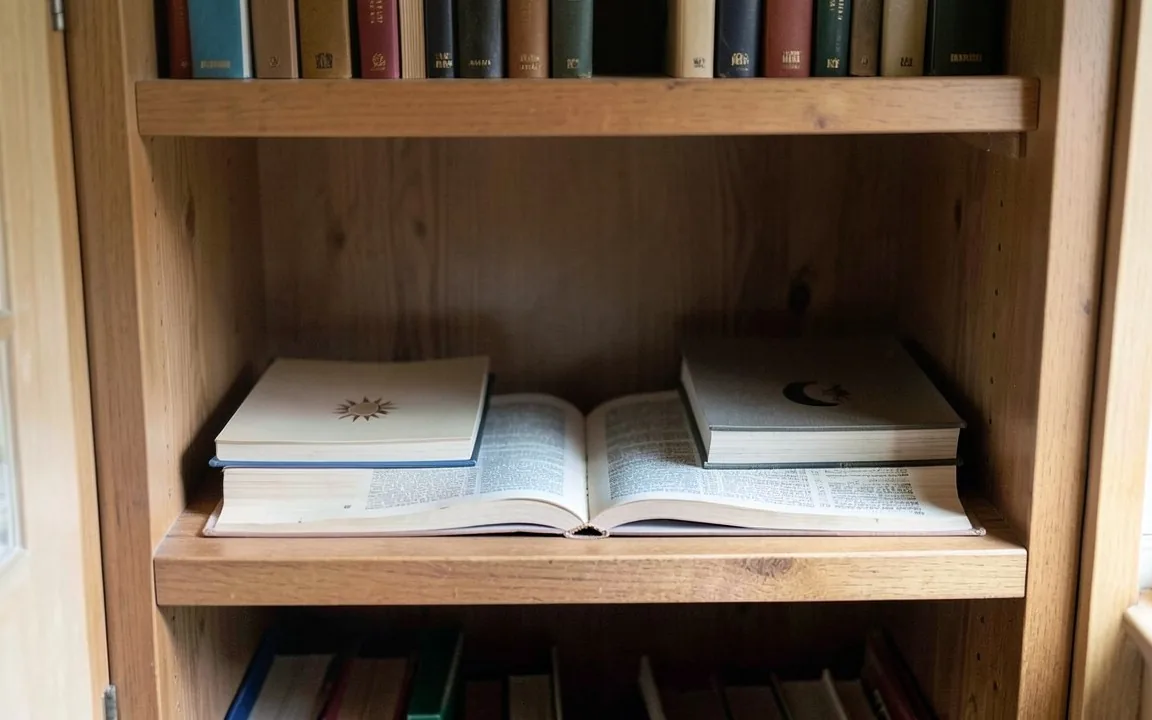
Arabic marks definiteness with a single, versatile prefix: ال (al-). It attaches directly to a noun (no space, no hyphen) and corresponds roughly to English "the." But unlike English "the," ال interacts with the noun's initial consonant in a specific way: half of Arabic letters cause the l in al- to assimilate (merge) with the following sound, while the other half leave it pronounced.
These are traditionally called sun letters (الحروف الشمسية al-ḥurūf al-shamsiyya) and moon letters (الحروف القمرية al-ḥurūf al-qamariyya), after the words for "sun" (شمس shams) and "moon" (قمر qamar) - one triggering assimilation, the other not.
This reference explains the pronunciation rule, lists every letter in each category, and covers the contexts where ال is required, optional, or dropped. For how the definite article interacts with possession, see the Arabic idāfa construction reference. For pronunciation of each letter in context, see the Arabic pronunciation guide. For broader grammar context, see the Arabic grammar rules guide.
The Arabic Definite Article Al: The Basic Form ال
The definite article ال is a prefix written attached to the noun:
- كِتَاب kitāb = a book (indefinite)
- الكِتَاب al-kitāb = the book (definite)
In pronunciation, the initial a of ال is weak (a glottal stop called hamzat al-waṣl) and disappears in connected speech. Only the l remains. When the word begins a sentence the a is pronounced.
The Sun / Moon Distinction
When ال attaches to a word starting with a moon letter, the l is pronounced normally:
- القمر al-qamar (the moon) - ل is clear.
- الكتاب al-kitāb (the book) - ل is clear.
When it attaches to a word starting with a sun letter, the l assimilates: it is not pronounced; instead, the initial consonant of the word is doubled:
- الشمس al-shams is pronounced ash-shams (not *al-shams). The l disappears; the sh doubles.
- التفاح al-tuffāḥ is pronounced at-tuffāḥ.
- النهر al-nahr is pronounced an-nahr.
In writing, the ل is still written; only the pronunciation changes. Diacritic-marked Arabic often uses a shaddah ّ on the sun letter to indicate gemination: الشَّمس.
The Sun Letters (14)
Table 1. Sun letters and their examples.
| Letter | Name | Example | Pronunciation |
|---|---|---|---|
| ت | tā' | التِّمْسَاح at-timsāḥ | the crocodile |
| ث | thā' | الثَّلْج ath-thalj | the snow |
| د | dāl | الدَّرْس ad-dars | the lesson |
| ذ | dhāl | الذَّهَب adh-dhahab | the gold |
| ر | rā' | الرَّجُل ar-rajul | the man |
| ز | zāy | الزَّهْر az-zahr | the flower (zahr; also zahra) |
| س | sīn | السَّلَام as-salām | the peace |
| ش | shīn | الشَّمْس ash-shams | the sun |
| ص | ṣād | الصَّوت aṣ-ṣawt | the voice |
| ض | ḍād | الضَّيْف aḍ-ḍayf | the guest |
| ط | ṭā' | الطَّالِب aṭ-ṭālib | the student |
| ظ | ẓā' | الظَّهْر aẓ-ẓuhr | the back / noon |
| ل | lām | اللَّيْل al-layl (pronounced al-layl; the l of al- merges with the initial l) | the night |
| ن | nūn | النَّهْر an-nahr | the river |
The sun letters are all pronounced with the tongue at the front of the mouth (alveolar or dental), the same general region as the letter ل. That phonetic similarity drives the assimilation.
The Moon Letters (14)
Table 2. Moon letters and their examples.
| Letter | Name | Example | Pronunciation |
|---|---|---|---|
| ا / أ | alif / hamza | الأَرْض al-arḍ | the earth |
| ب | bā' | البَيْت al-bayt | the house |
| ج | jīm | الجَبَل al-jabal | the mountain |
| ح | ḥā' | الحَقّ al-ḥaqq | the truth |
| خ | khā' | الخُبْز al-khubz | the bread |
| ع | 'ayn | العَيْن al-'ayn | the eye |
| غ | ghayn | الغَرْب al-gharb | the west |
| ف | fā' | الفِيل al-fīl | the elephant |
| ق | qāf | القَمَر al-qamar | the moon |
| ك | kāf | الكِتَاب al-kitāb | the book |
| م | mīm | المَسْجِد al-masjid | the mosque |
| ه | hā' | الهَاتِف al-hātif | the phone |
| و | wāw | الوَلَد al-walad | the boy |
| ي | yā' | اليَوم al-yawm | the day |
Moon letters are pronounced farther back in the mouth (velar, pharyngeal, guttural) or at the lips, different regions from ل. The l stays distinct in pronunciation.
Memory aid: Say the sun-letter names in sequence and you'll notice they all feel "dental/alveolar." The moon-letter names are a mix of bilabial (b, m), guttural (kh, gh, ḥ, ', h), and back-of-mouth (q, k).
When Al Is Used
- Specific, known reference: الكِتَابُ جَدِيد (al-kitābu jadīd) The book is new (a specific book).
- Abstract / universal concepts: العِلْمُ نُور (al-'ilmu nūr) Knowledge is light.
- Body parts in context: غَسَلَ يَدَهُ (washed his hand) - idāfa, not al-.
- Proper place names (some take al-, some don't): العِرَاق al-'Irāq (Iraq), مِصْر Miṣr (Egypt) - no al-.
- Unique entities: الشَّمْس ash-shams (the sun).
When Al Is Dropped
In an idāfa construction
In a possessive phrase (إِضَافَة iḍāfa), the first noun (the possessed) never takes ال. Only the last noun in the chain may take it.
- Wrong: الكِتَابُ الطَّالِب (*the book of the student) as a phrase.
- Right: كِتَابُ الطَّالِب (kitābu aṭ-ṭālib) the student's book / the book of the student.
- The first noun (kitāb) has no al-; the second (aṭ-ṭālib) has al-.
See the Arabic idāfa construction reference for the full rules.
With proper names
Personal names usually don't take al-: مُحَمَّد Muḥammad, عَلِيّ 'Alī.
After certain prepositions
The preposition ب (bi, with) + definite noun: بِالكِتَابِ (bi-l-kitābi, with the book) - the alif of ال is not pronounced but the lām is still written.
With vocatives
Calling out: يَا رَجُل (yā rajul, O man) - no al-.
Hamzat al-Waṣl: The Silent Alif
The ا at the start of ال is a special hamza called hamzat al-waṣl (همزة الوصل, "connecting hamza"). Its rules:
- At the start of an utterance: pronounced as a short a.
- In the middle of an utterance: silent; the preceding syllable connects directly to the l.
Example:
- الكتاب at the start: al-kitāb.
- في الكتاب (in the book): pronounced fi-l-kitāb (no a between fi and l).
- هذا الكتاب: pronounced hādha-l-kitāb.
Al + Sun Letter in Detail
Let's trace the pronunciation of الشمس (the sun) carefully:
- Written: الشمس (al-shams)
- Pronounced at sentence start: ash-shams (a + sh-sh; the l is dropped, sh doubles)
- Pronounced mid-sentence: -sh-shams (no initial a either)
- Written with full diacritics: اَلشَّمْسُ (a sukun would be on the ل of al, but convention often omits it and places shaddah on the sun letter)
Common Mistakes Learners Make
- Saying "al" before every sun letter. Wrong: *al-shams. Right: ash-shams.
- Forgetting al- entirely. Definite nouns in contexts like adjective agreement need al-: البيت الجديد (the new house), not *بيت الجديد.
- Adding al- to the first noun of an idāfa. Wrong: *al-kitāb al-ṭālib. Right: kitāb aṭ-ṭālib.
- Pronouncing al- before a connector. في الكتاب is fil-kitāb, not *fi al-kitāb.
- Capitalizing al- in English transliteration of Arabic names. Convention is "al-Khwārizmī" or sometimes "Khwarizmi"; avoid "Al-Khwarizmi" with both al and proper-noun capitals mid-sentence.
- Treating لا (lā, no) as al. Totally unrelated. لا is a negation word.
- Adding al- to a noun that rejects it. Names like مِصْر (Egypt), دِمَشْق (Damascus) take no al-.
- Missing the shaddah on sun letters in writing. Some orthographies mark it; check your source.
Quick Reference: Sun vs Moon at a Glance
Sun letters (14) - ال assimilates to double: ت ث د ذ ر ز س ش ص ض ط ظ ل ن
Moon letters (14) - ال stays as al-: ا ب ج ح خ ع غ ف ق ك م ه و ي
Phonetic logic: sun letters are front-of-mouth (tongue touches teeth or ridge); moon letters are back-of-mouth or lip consonants.
See Also
- Arabic alphabet complete guide for beginners
- Arabic pronunciation guide for English speakers
- Arabic grammar rules complete beginners guide
- Arabic idafa construction reference
- Arabic root system trilateral roots reference
- Arabic verb forms 1-10 reference
- Arabic verb conjugation present past tense guide
- Arabic pronouns attached detached reference
Frequently asked questions
Why are they called sun and moon letters?
Because the Arabic words for sun (شمس) and moon (قمر) exemplify the two behaviors: al-shams assimilates; al-qamar does not.
Is the written ل in sun-letter cases ever pronounced?
No. With sun letters the ل is written but silent; the following consonant is geminated (doubled) instead.
What does the shaddah do?
It marks gemination. In sun-letter words, the shaddah on the sun letter signals that the ل of al- has assimilated into a doubled consonant.
Do Arabic dialects follow the same rule?
Yes. All Arabic varieties use the sun/moon rule with minor pronunciation shifts in specific letters.
How do I memorize which letters are which?
Learn the 14 moon letters (or use phonetic logic: front-of-mouth/tongue-tip consonants are sun letters; lip and back-of-mouth consonants are moon letters).
Is al- always 'the'?
Usually, but not always. Some fixed expressions use al- where English doesn’t (العَرَبِيَّة for Arabic). It can also mark generic or abstract reference.
Can a sentence have multiple al-s?
Yes. Adjectives agreeing with a definite noun must also take al-: الكتاب الجديد (al-kitāb al-jadīd, the new book).
Why does Arabic call these sun and moon letters?
Because the words for sun (شمس) and moon (قمر) exemplify the two categories: one assimilates in al-shams, the other doesn't in al-qamar.
How do I learn which letters are which?
Start by learning the moon letters (14 less, easier to list). By elimination, the remaining 14 are sun letters. Or learn the phonetic logic: if the consonant is front-of-mouth near the tongue tip, it's a sun letter.