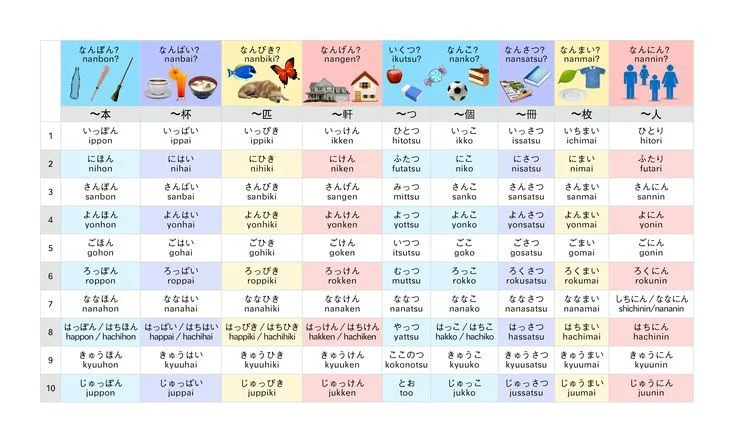
Japanese uses counters (助数詞 josuushi), which are small words that attach to numbers when counting objects, just as Chinese uses classifiers.
In English, you mostly count bare - "three books, four dogs" - but in Japanese you need the right counter for the object's category: 三冊の本 sansatsu no hon (three books, using 冊 for bound volumes) or 四匹の犬 yonhiki no inu (four dogs, using 匹 for small animals). On top of that, counters interact irregularly with certain numbers (1, 3, 6, 8, 10), producing sound changes that must be memorized.
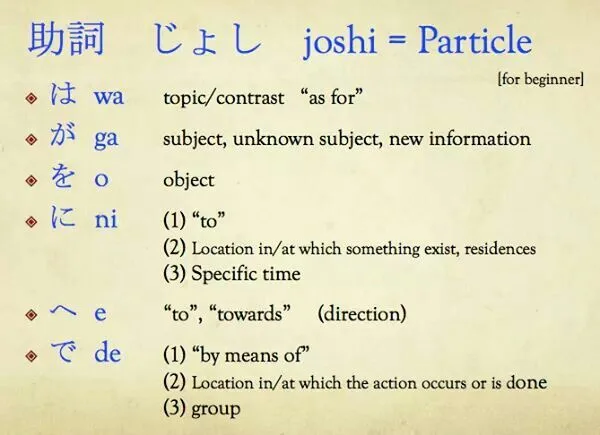
This reference covers the most essential Japanese counters, the number-plus-counter readings including irregular pronunciations, and the categories of objects each counter serves. For basic counting in numbers 1-10, see the Japanese counting numbers and counters guide. For the particles that surround counted phrases, see the Japanese particles reference.
Basic Pattern
The typical structure:
Number + Counter
- 一人 hitori - one person
- 二冊 nisatsu - two (books)
- 三匹 sanbiki - three (small animals)
The counted phrase often appears as an adverb-like quantity: 本を三冊買った (hon o sansatsu katta) - "I bought three books." Some structures use の: 三冊の本 (sansatsu no hon) - "three books" as a noun phrase.
Native Japanese Counting (つ) - General Objects
For many everyday items where a specific counter isn't known or doesn't fit, the native Japanese counter つ is used with the native numbers 1-10.
Table 1. Native counting 1-10 with つ.
| Number | Japanese | Kanji |
|---|---|---|
| 1 | hitotsu | 一つ |
| 2 | futatsu | 二つ |
| 3 | mittsu | 三つ |
| 4 | yottsu | 四つ |
| 5 | itsutsu | 五つ |
| 6 | muttsu | 六つ |
| 7 | nanatsu | 七つ |
| 8 | yattsu | 八つ |
| 9 | kokonotsu | 九つ |
| 10 | tou | 十 (no つ) |
Beyond 10, Sino-Japanese numbers with specific counters take over.
Use つ for fruits, abstract items, small objects without a specific counter. Beyond 10 there is no つ-system; switch to specific counters.
Counters for People: 人 (nin / ri)
Table 2. Counting people.
| Number | Japanese | Kanji |
|---|---|---|
| 1 | hitori | 一人 |
| 2 | futari | 二人 |
| 3 | sannin | 三人 |
| 4 | yonin | 四人 |
| 5 | gonin | 五人 |
| 6 | rokunin | 六人 |
| 7 | shichinin / nananin | 七人 |
| 8 | hachinin | 八人 |
| 9 | kyuunin | 九人 |
| 10 | juunin | 十人 |
Note that 1 and 2 use irregular readings (hitori, futari). From 3 onward the counter reads "nin" with Sino-Japanese numbers.
Counters for Animals: 匹 (hiki), 頭 (tou), 羽 (wa)
Table 3. Counting animals by size.
| Counter | Use | Reading pattern |
|---|---|---|
| 匹 hiki | small animals (cats, dogs, fish) | ippiki, nihiki, sanbiki, yonhiki, gohiki, roppiki, nanahiki, happiki, kyuuhiki, juppiki |
| 頭 tou | large animals (cows, horses, elephants) | ittou, nitou, santou, yontou, gotou, rokutou, shichitou, hattou, kyuutou, juttou |
| 羽 wa | birds and rabbits | ichiwa, niwa, sanba/sanwa, yonwa, gowa, rokuwa, shichiwa, hachiwa, kyuuwa, juuwa |
Notice the sound changes with 匹: 1 becomes ippiki (double consonant), 3 becomes sanbiki (voicing), 6 becomes roppiki, 10 becomes juppiki.
Counter for Long, Cylindrical Objects: 本 (hon)
Used for bottles, pens, umbrellas, trees, fingers, phone calls, even train rails.
Table 4. Counting with 本.
| Number | Reading | Kanji |
|---|---|---|
| 1 | ippon | 一本 |
| 2 | nihon | 二本 |
| 3 | sanbon | 三本 |
| 4 | yonhon | 四本 |
| 5 | gohon | 五本 |
| 6 | roppon | 六本 |
| 7 | nanahon / shichihon | 七本 |
| 8 | happon | 八本 |
| 9 | kyuuhon | 九本 |
| 10 | juppon | 十本 |
Same sound-change pattern as 匹: 1, 3, 6, 8, 10 get modified.
Counter for Flat Objects: 枚 (mai)
For paper, stamps, tickets, CDs, pizzas, shirts.
Table 5. Counting with 枚.
| Number | Reading | Kanji |
|---|---|---|
| 1 | ichimai | 一枚 |
| 2 | nimai | 二枚 |
| 3 | sanmai | 三枚 |
| 4 | yonmai | 四枚 |
| 5 | gomai | 五枚 |
| 6 | rokumai | 六枚 |
| 7 | nanamai / shichimai | 七枚 |
| 8 | hachimai | 八枚 |
| 9 | kyuumai | 九枚 |
| 10 | juumai | 十枚 |
枚 is regular - no sound changes. This is one of the easiest counters.
Counter for Machines and Vehicles: 台 (dai)
For cars, computers, televisions, washing machines.
Table 6. Counting with 台.
| Number | Reading |
|---|---|
| 1 | ichidai |
| 2 | nidai |
| 3 | sandai |
| 4 | yondai |
| 5 | godai |
| 6 | rokudai |
| 7 | nanadai |
| 8 | hachidai |
| 9 | kyuudai |
| 10 | juudai |
Also regular.
Counter for Books: 冊 (satsu)
For bound volumes: books, magazines, notebooks.
Table 7. Counting with 冊.
| Number | Reading |
|---|---|
| 1 | issatsu |
| 2 | nisatsu |
| 3 | sansatsu |
| 4 | yonsatsu |
| 5 | gosatsu |
| 6 | rokusatsu |
| 7 | nanasatsu / shichisatsu |
| 8 | hassatsu |
| 9 | kyuusatsu |
| 10 | jussatsu / jissatsu |
Pattern: 1, 8, 10 get modified (issatsu, hassatsu, jussatsu).
Counter for Small Objects: 個 (ko)
A generic counter for small spherical or lumpy objects: apples, erasers, rocks.
Table 8. Counting with 個.
| Number | Reading |
|---|---|
| 1 | ikko |
| 2 | niko |
| 3 | sanko |
| 4 | yonko |
| 5 | goko |
| 6 | rokko |
| 7 | nanako |
| 8 | hakko |
| 9 | kyuuko |
| 10 | jukko / jikko |
Sound changes: 1 (ikko), 6 (rokko), 8 (hakko), 10 (jukko).
Other Important Counters
Table 9. Additional counters.
| Counter | Use | Example |
|---|---|---|
| 階 (kai) | floors of a building | 一階 ikkai (1st floor), 二階 nikai, 三階 sangai |
| 回 (kai) | times (occurrences) | 一回 ikkai (one time) |
| 杯 (hai) | cups, bowls of liquid | 一杯 ippai, 二杯 nihai, 三杯 sanbai |
| 分 (fun/pun) | minutes | 一分 ippun, 二分 nifun, 三分 sanpun |
| 時 (ji) | o'clock (hours on clock) | 一時 ichiji, 二時 niji, 四時 yoji, 七時 shichiji |
| 時間 (jikan) | hours (duration) | 一時間 ichijikan |
| 日 (nichi/ka) | days | 一日 tsuitachi (1st of month), ichinichi (one day, duration) |
| 歳 (sai) | years of age | 一歳 issai, 二歳 nisai, 八歳 hassai, 二十歳 hatachi |
| 円 (en) | yen (money) | 百円 hyakuen, 千円 sen'en |
| 度 (do) | degrees, times | 一度 ichido |
The Big Four Sound-Change Numbers
A pattern emerges: the numbers 1, 3, 6, 8, 10 often cause sound changes when combined with counters starting with h-, k-, s-, t-. Memorize these:
Table 10. Common sound changes with counters beginning h, k, s, t.
| Counter start | 1 | 3 | 6 | 8 | 10 |
|---|---|---|---|---|---|
| h (hon, hiki, hai) | ippon / ippiki | sanbon / sanbiki | roppon | happon | juppon |
| k (kai, ko) | ikkai, ikko | sangai | rokkai, rokko | hakkai, hakko | jukkai, jukko |
| s (satsu, sai) | issatsu | sansatsu | rokusatsu | hassatsu | jussatsu |
| t (tou, tsu) | ittou | santou | rokutou | hattou | juttou |
With counters starting m (mai, meetoru), f, n, r there are usually no changes.
Native Numbers vs Sino Numbers
Japanese has two number systems:
- Native Japanese (wago): hitotsu, futatsu, mittsu. Used with the つ counter and in traditional/literary contexts.
- Sino-Japanese (kango): ichi, ni, san. Used with most counters, in all modern arithmetic, prices, and times.
Table 11. Quick comparison 1-10.
| Number | Native (wago) | Sino (kango) |
|---|---|---|
| 1 | hitotsu | ichi |
| 2 | futatsu | ni |
| 3 | mittsu | san |
| 4 | yottsu | shi / yon |
| 5 | itsutsu | go |
| 6 | muttsu | roku |
| 7 | nanatsu | shichi / nana |
| 8 | yattsu | hachi |
| 9 | kokonotsu | kyuu / ku |
| 10 | tou | juu |
4 (shi = "death") and 9 (ku = "suffering") are sometimes read yon and kyuu to avoid unlucky associations, especially in medical, hotel, and age contexts.
Common Mistakes Learners Make
- Using つ beyond 10. つ only works for 1-10. From 11 onward, use a specific counter.
- Forgetting sound changes. "Sanhon" is wrong; "sanbon" is right with 本 and 匹.
- Using hito for 人 always. 3 people is sannin, not *hitonin or *sanhito.
- Mixing native and Sino numbers. With 冊 use Sino: sansatsu, not *mittsu-satsu.
- Skipping counters in polite speech. "Three books, please" with just 三本 is fine; adding counter distinguishes 本 (hon, books) from 本 (hon, long objects).
- Miscounting time vs hours. 三時 (sanji = 3 o'clock) vs 三時間 (sanjikan = 3 hours).
- Reading 二十歳 as "nijuu-sai." It's read hatachi (twenty years old) - one of many irregular readings.
- Confusing 日 readings. 一日 as "one day" (duration) is ichinichi; 一日 as "the 1st of the month" is tsuitachi.
Quick Reference
- つ: native counter for general objects 1-10.
- 人 (nin/ri): people.
- 匹 (hiki): small animals.
- 頭 (tou): large animals.
- 羽 (wa): birds and rabbits.
- 本 (hon): long cylindrical.
- 枚 (mai): flat.
- 冊 (satsu): books.
- 台 (dai): machines.
- 個 (ko): small lumpy.
- 杯 (hai): cups of liquid.
- 階 (kai): floors.
Memorize the sound changes at 1, 3, 6, 8, 10.
See Also
- Japanese counting numbers counters guide
- Japanese particles wa ga o ni de to reference
- Japanese verb conjugation u-verbs ru-verbs irregular reference
- Japanese verb conjugation beginners guide
- Japanese grammar particles complete guide
- Hiragana complete guide chart and stroke order
- Katakana complete guide
- Japanese keigo honorific language reference
Frequently asked questions
Why are there two number systems?
Native Japanese (wago) numbers and Sino-Japanese (kango) numbers developed in parallel. Native numbers are used with the つ counter and in traditional contexts; Sino numbers dominate arithmetic, prices, and most specific counters.
Do I have to memorize every counter?
Learn the top 10-15 first. The native つ is a useful fallback for general objects 1-10, and 個 covers many small items.
Why do the same numbers change with different counters?
Phonetic rules (gemination, rendaku) trigger sound changes when specific numbers meet counters starting with h, k, s, or t. The pattern is predictable once learned.
Is 一つ or 一個 correct for one apple?
Both work. りんご一つ is slightly more traditional/informal; りんご一個 is slightly more formal. Both are widely used.
How do I count beyond 100 with counters?
Sino numbers combine normally: 百本 (hyappon = 100 long objects). Sound changes still apply at 1, 3, 6, 8, 10, 100.
What is the counter 名?
名 (mei) counts people in formal or written contexts such as registrations and invitations: 十名 (ten people).
Is 四 always yon?
Yon is common with counters to avoid ‘shi’ (which sounds like ‘death’), but some readings are fixed: 四時 (yoji, 4 o’clock), not *yonji.
Why are there two number systems in Japanese?
Native Japanese (yamato kotoba) numbers and Sino-Japanese numbers developed in parallel. Native numbers surround everyday objects and traditional contexts; Sino numbers cover arithmetic, prices, specific counters.
How do you count beyond 100 with counters?
Sino numbers combine with counters normally: 百本 (hyappon = 100 long objects). Sound changes apply (ippon, sanbon, hyappon, etc.).
What about the counter 名 (mei)?
名 counts people in formal or written contexts, especially in registrations, invitations, etc. 10 people = 十名 (juumei).
Is 四 always read as yon or shi?
Yon is more common with counters (yonhon, yonkai) because shi sounds like "death." But 四時 (4 o'clock) is always yoji. Check each context.