Numbers in Japanese present an interesting challenge because there are two parallel number systems in daily use, and on top of that, counting most things requires special words called "counters" that attach to numbers based on the category of the thing being counted.
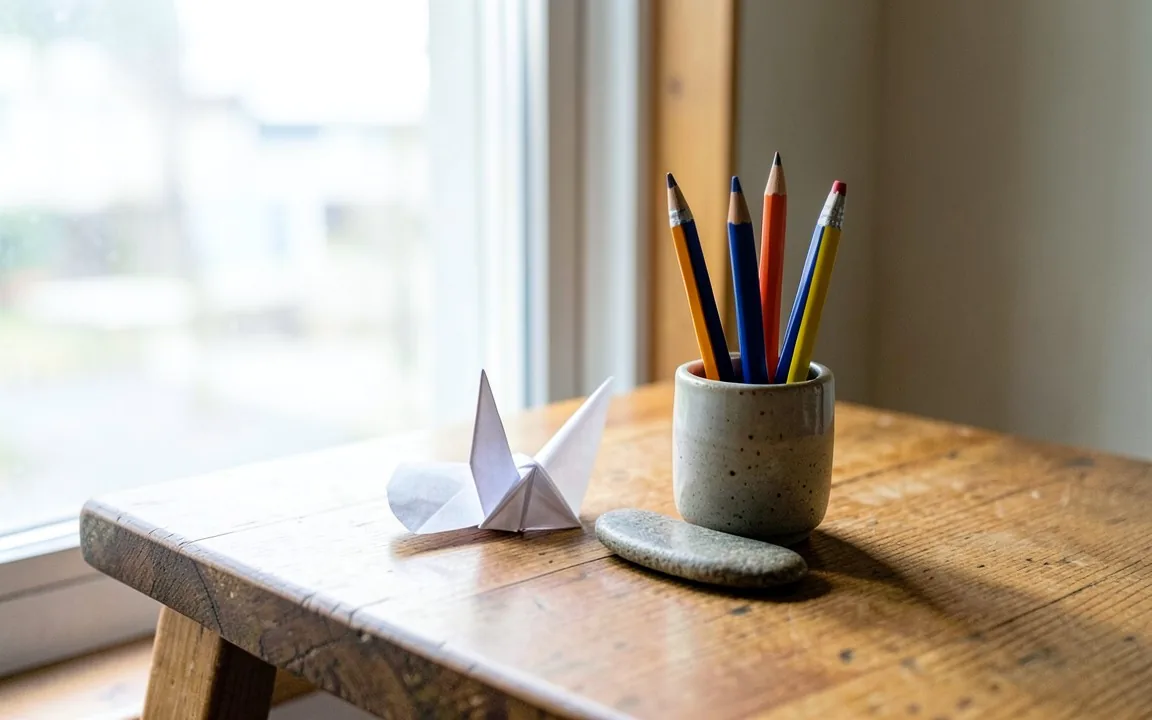
While English simply says "three cats" or "two books," Japanese says the equivalent of "three animal-units of cats" or "two flat-thing-units of books." These counters are a fundamental part of natural Japanese speech and cannot be avoided.
The two number systems both appear in everyday contexts and must both be learned. The first system, called on'yomi or Sino-Japanese numbers, derives from Chinese and forms the basis for most counting, arithmetic, and time expressions.
The second system, called kun'yomi or native Japanese numbers, is used for certain counting contexts and only works for numbers one through ten (with a separate word for "ten" and nothing beyond). Understanding when each system applies - and which counters use which system - is a key part of Japanese numerical fluency.
Beyond the numbers themselves, the Japanese time system, date system, and age expressions each have their own patterns that build on the core number vocabulary. Telling time in Japanese is straightforward once you know the numbers, but expressions like days of the week and months of the year each have their own forms to memorize.
This guide provides the complete foundation: both number systems through 10,000, all major counters with their associated sound changes, time and date expressions, age expressions, and enough practice examples to make Japanese numbers feel natural.
The Sino-Japanese Number System (On'yomi)
This is the primary counting system for most purposes. It is the system used for arithmetic, telephone numbers, prices, floors of buildings, and most counters.
Numbers 1-10
| Number | Kanji | Hiragana | Romaji |
|---|---|---|---|
| 1 | 一 | いち | ichi |
| 2 | 二 | に | ni |
| 3 | 三 | さん | san |
| 4 | 四 | し / よん | shi / yon |
| 5 | 五 | ご | go |
| 6 | 六 | ろく | roku |
| 7 | 七 | しち / なな | shichi / nana |
| 8 | 八 | はち | hachi |
| 9 | 九 | く / きゅう | ku / kyuu |
| 10 | 十 | じゅう | juu |
Note the two readings for 4, 7, and 9. The alternates exist because し (4) sounds like 死 (death) and く (9) sounds like 苦 (suffering). In contexts where avoiding unlucky associations matters - hospital room numbers, gift quantities, etc. - よん and きゅう are preferred. In everyday counting and with counters, both forms exist and which one to use depends partly on the counter and partly on regional preference.
Numbers 11-99
Japanese numbers are completely regular beyond 10. Eleven is "ten-one" (juuichi), twelve is "ten-two" (juuni), twenty is "two-tens" (nijuu), twenty-one is "two-tens-one" (nijuuichi), and so on.
| Number | Kanji | Romaji |
|---|---|---|
| 11 | 十一 | juuichi |
| 12 | 十二 | juuni |
| 20 | 二十 | nijuu |
| 21 | 二十一 | nijuuichi |
| 30 | 三十 | sanjuu |
| 40 | 四十 | yonjuu |
| 50 | 五十 | gojuu |
| 60 | 六十 | rokujuu |
| 70 | 七十 | nanajuu |
| 80 | 八十 | hachijuu |
| 90 | 九十 | kyuujuu |
| 99 | 九十九 | kyuujuukyuu |
Numbers 100-10,000
| Number | Kanji | Romaji |
|---|---|---|
| 100 | 百 | hyaku |
| 200 | 二百 | nihyaku |
| 300 | 三百 | sanbyaku* |
| 400 | 四百 | yonhyaku |
| 500 | 五百 | gohyaku |
| 600 | 六百 | roppyaku* |
| 700 | 七百 | nanahyaku |
| 800 | 八百 | happyaku* |
| 900 | 九百 | kyuuhyaku |
| 1,000 | 千 | sen |
| 2,000 | 二千 | nisen |
| 3,000 | 三千 | sanzen* |
| 4,000 | 四千 | yonsen |
| 8,000 | 八千 | hassen* |
| 10,000 | 万 | man |
*Note the sound changes: 300 (sanbyaku), 600 (roppyaku), 800 (happyaku), 3000 (sanzen), 8000 (hassen). These irregular forms must be memorized as they appear frequently.
The Native Japanese Number System (Kun'yomi)
The native system is used for a smaller set of contexts but appears regularly enough to require learning. It only covers 1-10 and the word for "10" itself.
| Number | Hiragana | Romaji | Notes |
|---|---|---|---|
| 1 | ひとつ | hitotsu | |
| 2 | ふたつ | futatsu | |
| 3 | みっつ | mittsu | |
| 4 | よっつ | yottsu | |
| 5 | いつつ | itsutsu | |
| 6 | むっつ | muttsu | |
| 7 | ななつ | nanatsu | |
| 8 | やっつ | yattsu | |
| 9 | ここのつ | kokonotsu | |
| 10 | とお | too (tō) |
The native system is used in a few specific contexts:
- General counting of small objects (especially without a specified counter)
- Age, with a special reading for 20 (hatachi)
- Certain traditional expressions
- When no counter applies and quantity below 10 is expressed informally
Learning tip: Learn the native numbers as a separate set, not as alternatives to the Sino-Japanese numbers. The two systems are not interchangeable - each has its domains. Memorizing them side by side ("ichi = hitotsu," "ni = futatsu") builds the parallel vocabulary naturally.
Japanese Counters: The Complete System
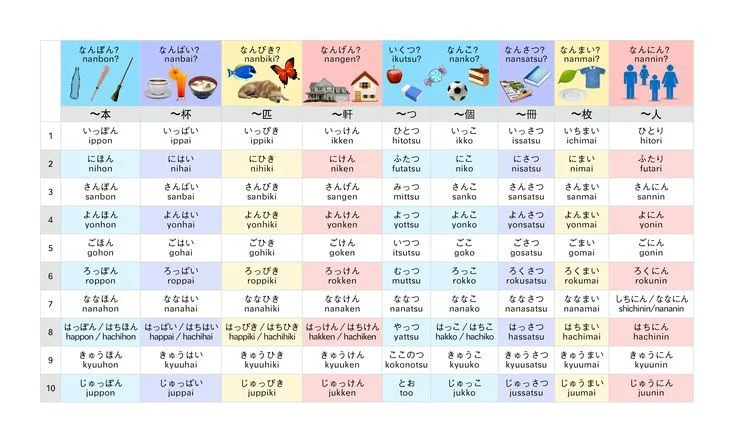
Counters are suffixes that attach to Sino-Japanese numbers to count specific categories of objects. The category determines which counter to use. The combination of number + counter often involves sound changes (similar to the 300/600/800 changes above).
The Most Common Counters
| Counter | Kana | Romaji | Used For | Examples |
|---|---|---|---|---|
| 本 | ほん | hon | Long cylindrical things (pens, bottles, trees, roads) | いっぽん (ippon) 1, にほん (nihon) 2, さんぼん (sanbon) 3 |
| 枚 | まい | mai | Flat thin things (paper, plates, shirts, CDs) | いちまい (ichimai) 1, にまい (nimai) 2, さんまい (sanmai) 3 |
| 冊 | さつ | satsu | Bound volumes (books, notebooks, magazines) | いっさつ (issatsu) 1, にさつ (nisatsu) 2 |
| 台 | だい | dai | Machines and vehicles (cars, computers, bikes) | いちだい (ichidai) 1, にだい (nidai) 2 |
| 匹 | ひき | hiki | Small to medium animals | いっぴき (ippiki) 1, にひき (nihiki) 2, さんびき (sanbiki) 3 |
| 頭 | とう | tou | Large animals (horses, cattle, elephants) | いっとう (ittou) 1, にとう (nitou) 2 |
| 羽 | わ | wa | Birds and rabbits | いちわ (ichiwa) 1, にわ (niwa) 2 |
| 杯 | はい | hai | Cups and glasses of liquid | いっぱい (ippai) 1, にはい (nihai) 2 |
| 個 | こ | ko | Small objects (general) | いっこ (ikko) 1, にこ (niko) 2 |
| 人 | にん | nin | People (except 1 and 2 people) | さんにん (sannin) 3, よにん (yonin) 4 |
| 階 | かい | kai | Floors of a building | いっかい (ikkai) 1st, にかい (nikai) 2nd |
| 番 | ばん | ban | Numbers in a sequence/ranking | いちばん (ichiban) 1st/most, にばん (niban) 2nd |
| 回 | かい | kai | Number of times (occurrences) | いっかい (ikkai) once, にかい (nikai) twice |
Special Forms for 1 and 2 People
The counter for people (人 - nin) has irregular forms for 1 and 2:
- 1 person: ひとり (hitori) - not "ichi-nin"
- 2 people: ふたり (futari) - not "ni-nin"
- 3+ people: さんにん (sannin), よにん (yonin), etc. - regular forms
Counter Sound Changes: Key Patterns
Many counters trigger consonant changes when combined with certain numbers. The pattern follows phonological harmony rules.
| Number | + hon (cylindrical) | + hiki (small animals) | + kai (floors/times) |
|---|---|---|---|
| 1 | ippon | ippiki | ikkai |
| 2 | nihon | nihiki | nikai |
| 3 | sanbon | sanbiki | sankai |
| 4 | yonhon | yonhiki | yonkai |
| 5 | gohon | gohiki | gokai |
| 6 | roppon | roppiki | rokkai |
| 7 | nanahon | nanahiki | nanakai |
| 8 | happon | happiki | hakkai |
| 9 | kyuuhon | kyuuhiki | kyuukai |
| 10 | juppon | juppiki | jukkai |
Learning tip: The sound changes in counters follow a pattern: numbers ending in consonant-like sounds (1, 6, 8, 10) often double the initial consonant of the counter or change h-sounds to p-sounds. Rather than memorizing every combination, learn the pattern: "1, 6, 8, and 10 trigger changes in many counters" and practice the actual forms through repeated use.
Telling Time in Japanese
Time uses the Sino-Japanese number system. The word for "hour" is 時 (ji), and the word for "minute" is 分 (fun/pun).
Hours
| Time | Kanji | Hiragana | Romaji |
|---|---|---|---|
| 1:00 | 一時 | いちじ | ichi-ji |
| 2:00 | 二時 | にじ | ni-ji |
| 3:00 | 三時 | さんじ | san-ji |
| 4:00 | 四時 | よじ | yo-ji* |
| 5:00 | 五時 | ごじ | go-ji |
| 6:00 | 六時 | ろくじ | roku-ji |
| 7:00 | 七時 | しちじ | shichi-ji* |
| 8:00 | 八時 | はちじ | hachi-ji |
| 9:00 | 九時 | くじ | ku-ji* |
| 10:00 | 十時 | じゅうじ | juu-ji |
| 11:00 | 十一時 | じゅういちじ | juuichi-ji |
| 12:00 | 十二時 | じゅうにじ | juuni-ji |
*Special forms: 4 o'clock uses よじ (yoji, not yonji); 7 o'clock uses しちじ (shichiji) but ななじ (nanaji) is also acceptable; 9 o'clock uses くじ (kuji, not kyuuji).
Minutes
Minutes use 分 (fun/pun) with the same sound changes:
- 1 minute: いっぷん (ippun)
- 3 minutes: さんぷん (sanpun)
- 6 minutes: ろっぷん (roppun)
- 8 minutes: はっぷん (happun)
- 10 minutes: じゅっぷん (juppun)
- 15 minutes: じゅうごふん (juugo fun)
- 30 minutes: さんじゅっぷん (sanjuppun) or はん (han - half)
Time expressions in sentences:
- いまなんじですか - Ima nanji desu ka - What time is it now?
- にじです - Ni-ji desu - It is 2 o'clock.
- さんじはんに あいましょう - Sanji han ni aimashou - Let's meet at 3:30.
- くじじゅっぷんに おきました - Ku-ji juppun ni okimashita - I woke up at 9:10.
- しちじはんに ごはんを たべます - Shichi-ji han ni gohan wo tabemasu - I eat dinner at 7:30.
Dates and Calendar Expressions
Months
Months use the Sino-Japanese numbers followed by 月 (gatsu - month):
| Month | Kanji | Hiragana | Romaji |
|---|---|---|---|
| January | 一月 | いちがつ | ichi-gatsu |
| February | 二月 | にがつ | ni-gatsu |
| March | 三月 | さんがつ | san-gatsu |
| April | 四月 | しがつ | shi-gatsu |
| May | 五月 | ごがつ | go-gatsu |
| June | 六月 | ろくがつ | roku-gatsu |
| July | 七月 | しちがつ | shichi-gatsu |
| August | 八月 | はちがつ | hachi-gatsu |
| September | 九月 | くがつ | ku-gatsu |
| October | 十月 | じゅうがつ | juu-gatsu |
| November | 十一月 | じゅういちがつ | juuichi-gatsu |
| December | 十二月 | じゅうにがつ | juuni-gatsu |
Days of the Month
Days use 日 (nichi/ka) and have many irregular forms for the first two weeks:
- 1st: ついたち (tsuitachi)
- 2nd: ふつか (futsuka)
- 3rd: みっか (mikka)
- 4th: よっか (yokka)
- 5th: いつか (itsuka)
- 6th: むいか (muika)
- 7th: なのか (nanoka)
- 8th: ようか (youka)
- 9th: ここのか (kokonoka)
- 10th: とおか (tooka)
- 14th: じゅうよっか (juuyokka)
- 20th: はつか (hatsuka)
- 24th: にじゅうよっか (nijuuyokka)
- Other days: regular (11th = juuichinichi, 15th = juugonichi, etc.)
Age Expressions
Age uses the counter 歳 (sai) with the Sino-Japanese system, with one notable exception:
- 1 year old: いっさい (issai)
- 2 years old: にさい (nisai)
- 3 years old: さんさい (sansai)
- 10 years old: じゅっさい (jussai)
- 20 years old: はたち (hatachi) - special word, not "nijussai"
- 30 years old: さんじゅっさい (sanjussai)
Asking and stating age:
- なんさいですか - Nan-sai desu ka - How old are you?
- にじゅうさんさいです - Nijuusan-sai desu - I am 23 years old.
- こどもは ごさいです - Kodomo wa go-sai desu - The child is 5 years old.
Common Mistakes with Numbers and Counters
Using the wrong counter. The most frequent error. Using ほん (hon) for people, or にん (nin) for books, sounds as strange in Japanese as "three bloods of water" sounds in English. Learn the major counters with their categories clearly defined.
Forgetting the 1 and 2 people exception. People do not use "ichi-nin" and "ni-nin" - they use ひとり and ふたり. Using the regular forms sounds unnatural.
Ignoring sound changes. Saying "ichi-hon" instead of "ippon" or "roku-hon" instead of "roppon" is immediately noticeable and marks a speaker as a learner. The sound changes in common counters must be practiced until automatic.
Mixing up 4 o'clock and 40 minutes. よじ (yo-ji) is 4 o'clock; よんじゅっぷん (yonjuppun) is 40 minutes. The number 4 uses different readings depending on context.
Quick Reference: Numbers and Counters Cheat Sheet
Core Sino-Japanese numbers to memorize first: ichi, ni, san, shi/yon, go, roku, shichi/nana, hachi, ku/kyuu, juu
Sound change triggers: 1, 6, 8, 10 (and sometimes 3) cause consonant changes in many counters
People exception: 1 person = hitori, 2 people = futari
Age exception: 20 years old = hatachi
Top 5 most useful counters: mai (flat things), hon (long things), hiki (small animals), nin (people), kai (floors/times)
Conclusion and Next Steps
Japanese numbers and counters are learnable through consistent practice with real examples. The Sino-Japanese system is systematic and predictable beyond the irregular forms for 300, 600, 800, 3000, and 8000. The counters require category-by-category memorization, but the most common dozen counters cover an enormous range of daily situations.
After mastering the material in this guide, continue with:
- Days of the week (youbi expressions: nichiyoubi, getsuyoubi, kayoubi...)
- Japanese era names (gengou) used in official documents alongside Western years
- Large numbers beyond 10,000 (man, oku, chou)
- Fraction and decimal expressions in Japanese
- Price expressions and shopping vocabulary (all use Sino-Japanese numbers with yen)
Numbers appear in virtually every real-world Japanese interaction - shopping, making appointments, giving directions, reading timetables. Every hour of practice with Japanese numbers pays immediate dividends in daily functional ability.
Frequently asked questions
Do I need to memorize all counters at once?
No. Start with five to ten most common counters: mai, hon, nin, hiki, kai, and ko. These cover the majority of daily counting needs. Learn additional counters as you encounter them in context.
Why are there two number systems in Japanese?
Japanese absorbed Chinese numbers (on’yomi) historically alongside maintaining its native number words (kun’yomi). Both became embedded in different domains of use. The Chinese-origin system dominates because it is more regular and extends beyond 10.
What counter do I use if I don't know the right one?
For objects 1-10, the native Japanese numbers (hitotsu, futatsu…) work as a general counter when you don’t know the specific one. For objects above 10, the general counter ko works for most small objects.
Is the date format different in Japanese?
Yes. Japanese date format is year-month-day. The year uses nen, month uses gatsu, and day uses nichi or ka with many irregular forms for the first 10 days of the month.
Why do numbers like 300 and 600 have different pronunciations?
These are phonological sound changes that reduce awkward consonant clusters. 300 becomes sanbyaku, 600 becomes roppyaku, 800 becomes happyaku. They must be memorized as they appear very frequently.
Why are there two number systems?
Japanese absorbed Chinese numbers (on'yomi) historically alongside maintaining its native number words (kun'yomi). Both became embedded in different domains of use. The Chinese-origin system dominates because it is more regular and extends beyond 10, while native numbers only go to 10.
How do Japanese people write numbers - in kanji or Arabic numerals?
In horizontal text (most modern writing, digital communication), Arabic numerals (1, 2, 3...) are standard. In vertical text (traditional documents, some books), kanji numbers are used. Both are common and a literate Japanese person reads both fluently.